Sign In
 Free Newsletter


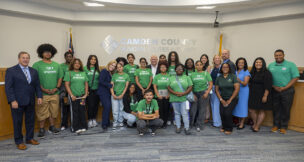
In December 2023, Hudson County Community College President Christopher Reber and New Jersey City University interim President Andrés Acebo signed the HCCC | NJCU CONNECT Transfer Agreement, joined by students who will take part in the program. - PROVIDED BY NJCU
In December 2023, Hudson County Community College President Christopher Reber and New Jersey City University interim President Andrés Acebo signed the HCCC | NJCU CONNECT Transfer Agreement, joined by students who will take part in the program. - PROVIDED BY NJCU
NJCU continues promising rise out of budget turmoil
Matthew Fazelpoor//February 26, 2024//


After a financial crisis ensnared New Jersey City University, the Hudson County institution is writing the next chapter of its story in the face of adversity.
A budget shortfall triggered a state comptroller investigation and subsequent report that found the school’s precarious fiscal state was caused by a combination of declining enrollment, increasing university spending and a misallocation of federal COVID-19 funds. In August, the state appointed Henry Amoroso as a fiscal monitor to steer the institution toward financial stability.
In between the revelation of the budget mess and the appointment of the monitor, last January, NJCU appointed Andres Acebo as interim president to take the helm at the age of 37. He took on the challenge he inherited head on.
Administrators had to make difficult decisions in the wake of the shortfall, such as program and faculty cuts, and other rightsizing efforts.
Despite the adversity, the NJCU community has continued to forge ahead, making several notable announcements, such as the signing of a memorandum of understanding with GLACO; an agreement with Hudson County Community College for a seamless transfer experience called HCCC/NJCU CONNECT; new mission and vision statements; significant growth in enrollment numbers; a partnership with the Jersey City police union to provide education opportunities for officers; and the release of its first academic master plan.
“We enter 2024 with a lot of momentum,” Acebo told NJBIZ. “Our campus has revealed very publicly, very proudly – its resilience. And by anchoring itself to the indispensability of its mission – a mission that we very proudly refined and refreshed.”
As he explained the thought process behind the mission and vision statements, Acebo noted that it’s not just about outcomes and results, but how the school goes about achieving them and with whom.

“It’s a reflection of institutional values. Because everything that this institution does needs to be filtered through that mission – with fidelity to that vision,” he said. “A lot of hard – everything from tackling a daunting structural operating deficit with clear eyes to the more systemic challenges and struggles – ones I don’t believe are insurmountable, just difficult.”
The discussion shifted to the process of digging out of the budget mess, dealing with the state monitor and where things stand.
“We’re living within our means,” Acebo stressed. “Which means there are operating constraints that by no means we profess to be a ‘new normal’ or a baseline expectation. But certainly, a level-setting. There are things that this institution used to do that we will no longer do – in order to really perfect and dive deep and double down on the things that really are the reason for why we are indispensable and why we belong in this higher education ecosystem in New Jersey. As we gather today, we are conservatively forecasting a balanced budget – which is clearly a tremendous achievement and feat as an organization, with sincere gratitude to the Legislature and the governor for their investment in the stabilization funding – most of which has been used to address both budgeted and unbudgeted capital needs on our campus. Just this time last year, that would have probably been more focused on plugging operating needs.”
Acebo said he is proud that the school has been able to put guardrails, institutional practices and internal controls into place. And he says that allows staff and faculty to be more forward thinking and focused on sustainability, with that stabilization funding, rather than survival.
Some systemic challenges remain, Acebo acknowledged, such as NJCU’s significant debt obligation and others. But he said the challenges are ones that other universities are facing as well. “We are now in a position where NJCU is tackling challenges that are not unique to our campus. The timing and the approach by which we’re tackling them are only unique because of the circumstances that led to the declaration of fiscal exigency,” he explained.
As he reflected on the journey to this moment, Acebo said he was recently asked if somebody would have told him in advance how this would turn out, whether he would have been surprised. “And with all the humility in the world, I would tell you what I told them – which is no,” said Acebo. “I wouldn’t have answered this call to serve this institution if I wasn’t confident of what the people on this campus could have accomplished.”
The positive momentum and weathering of the storm has led to great energy on the campus and around the NJCU community. Acebo described it as an “unprecedented level of engagement.” And while he believes that community engagement is at an all-time high, which boosts morale, Acebo is cognizant that the institution and its people have endured.
“So, there is also hope fatigue – of hoping that things will always be better. And it’s my charge to care for the people under my charge,” he continued. “Where you end up tripping over yourself is when you start confusing authority for leadership. People do what you say when you have authority. People take initiative and move things forward of their own volition when there’s a leader setting a vision and a course. And that’s what we’re seeing. There are staff who confronted and absorbed wage cuts – who are outperforming, and I would put them up against any of their peers at any other institution at this point.”
Acebo said he has tried to be a leader who emulates their resolve, rolling up his sleeves alongside the faculty and community. “I’ve missed more dinners with my children than I care to admit,” he said. “Although, they keep count. It’s the culmination of a lot of early mornings and a lot of late nights of being in the community. Because you can’t profess to be for it unless you are in it – building those relationships. This wasn’t just about fundraising. We didn’t just cut our way out of this.”
He pointed to the surging enrollment numbers – new graduate, undergraduate and transfer enrollment are all up double digits from this time last spring. “I’ve seen the work on the ground. It is not a blip. There’s a narrower academic portfolio,” Acebo explained. “We sunsetted a third of our portfolio. It’s more agile and malleable, a more community-oriented and responsive academic enterprise. And people are responding to that. Because we don’t just say, ‘we’re here’ in brick-and-mortar form. We stand for a very noble proposition – that you can pursue your promise and launch the rest of your life right in the community that you’re celebrated in and that you live your life in.”
As the week comes to a close, NJCU Enrollment Management has some exciting and encouraging news to share, as both undergraduate and graduate new student enrollment has realized significant year-to-date growth for the Spring 2024 semester!
Read about NJCU's growth in NJCU News!… pic.twitter.com/JGJU2kB7vj
— New Jersey City University (@NJCUniversity) January 26, 2024
Acebo said that while there are a number of initiatives and programs he is proud of, the collaboration with HCCC stands out because it publicly professes the revitalization of the campus that is underway. Stakeholders from both schools were able to fast track the initiative, which was in the works before Acebo took the helm.
The collaboration offers a clear pathway, Acebo stressed, which he said will only grow over time – removing obstacles and providing more opportunity for students.
While it is always difficult to suggest that a budget crisis and its program and faculty cuts had a silver lining, the situation did force NJCU to go back to its roots, refocus its efforts, and confront institutional and organizational shortcomings – toward atoning, doing better and almost laying a new foundation of sorts.
“As my mom would say, ‘rock bottom can sometimes be a solid foundation to rebuild on,’” Acebo said, acknowledging the efforts of his staff, the students and community. “I like to talk about people more than institutional structures. We are stewards of place.”
As for areas of focus, Acebo started with the recently released academic master plan. He described that as a strategic blueprint that takes mission, margin and market for its academic enterprise. “We’re being intentional when we say that we are meeting our students where they are – and what that actually means,” he explained. “Exploring every opportunity to expand child care services on our campus for working parents and caregivers who attend evening classes when child care facilities are closed – to enhancing our food insecurity outreach and job placement opportunities. As every prospective employer, every community partner that I engage with – I make the pitch about how lucky and fortunate they would be to have an NJCU alum in their workforce, because you’ll be hard pressed to find a more resilient human being.”
Just after the release of the master plan, another piece of good news emerged that offered more evidence of the school’s budget bounce back. On Feb. 20, Moody’s Investors Services upgraded NJCU’s outlook from negative to stable while affirming its outstanding Ba2 issuer and revenue bond ratings.
“Revision of the outlook to stable from negative reflects meaningful traction on financial turnaround plans which have allowed NJCU to significantly reduce operating losses and stabilize cash reserves,” Moody’s wrote in its analysis. “Despite this momentum, challenges remain around stagnant net tuition revenue, high leverage, and thin reserves. Improvements in financial strategy and risk management, and management credibility, which are governance considerations under Moody’s ESG methodology, are key drivers of the rating action.”
“I think where we are today is vastly stronger than we were this time last year – more cleareyed about our purpose,” Acebo said. “So much so that we’ve enshrined it in a new mission and vision with strategic focus and results that have been publicly scrutinized and vetted. So, an emboldened campus with unprecedented levels of engagement – but also a deep sense of responsibility to be faithful stewards of this enterprise.”