Sign In
Upcoming Event
 Free Newsletter

‘Really a gold rush’
How the New Jersey film industry is recovering from the pandemic
Daniel J. Munoz//June 21, 2021//
‘Really a gold rush’
How the New Jersey film industry is recovering from the pandemic
Daniel J. Munoz//June 21, 2021//


When NJBIZ last checked in on the state of showbiz here in October, few producers were willing to talk about what they were up to. Film and television production all but shut down during the pandemic, with a few exceptions for projects that imposed strict standards for social distancing, mask usage and sanitization. But now, with the state reopening, industry insiders are more forthcoming.
In a recent interview, Steven Gorelick, head of the New Jersey Motion Picture and Television Commission, ticked off a long list of projects underway in the state, and the addition of new studios that should ensure productions keep coming here. The Hulu series “Wu-Tang: An American Saga” is being filmed across Passaic, Essex and Hudson counties. NBC’s drama series “Law and Order: Organized Crime” is being filmed in Edison, Newark and Wayne. A remake of the 2014 film “Goodnight Mommy” is being filmed in Bedminster and will feature actress Naomi Watts in a lead role.
“We’re living in a multi-channel universe where demand for home entertainment has never been greater,” he said. “Now you have that same multi-channel universe that is desperate for productions and it took many months for things to get going.
You can see they’re really behind the eight-ball,” Gorelick said.
“The volume of calls we’re getting is remarkable,” he added. “I had no doubt we were going to fully recover from the pandemic.”
The film tax credit program certainly helps, and many producers and studio executives said it was a major factor in their decision to film in New Jersey. Under the program, film projects can be awarded a tax break equaling 30% of their production costs, or 35% for filming in the South Jersey counties of Atlantic, Burlington, Camden, Cape May, Cumberland, Gloucester, Mercer or Salem. Those counties are further from New York City, hence the added nudge from the state.
Use of the program fell sharply during the pandemic. According to figures from the New Jersey Economic Development Authority, which runs the program along with the state film commission, the state awarded 4 projects in the 2019 fiscal year totaling $6.1 million.
A total of $85.7 million of tax breaks went to 20 projects in fiscal year 2020, and $30.5 million to a combined 16 projects in fiscal 2021. The state still has nearly $120 million in unused tax breaks for 2021, according to NJEDA spokesperson Jake McNichol.

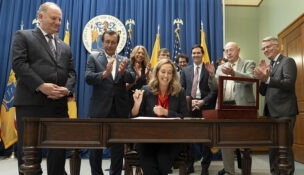
Gov. Phil Murphy brought the tax credit program back online in 2018, and expanded it earlier this year, when he signed a broad tax incentive bill that includes up to $2.6 billion of credits over the next 13 years.
The program has varying levels of requirements for how much film, TV and digital media projects can get reimbursed for by the state. Generally, the tax credits are for expenses directed to New Jersey companies.
Major projects before the pandemic included scenes of the Academy Award-winning 2019 film “Joker” filmed in Newark and Jersey City. HBO’s “The Many Saints of Newark” – a prequel of sorts to the hit series “The Sopranos” – was filmed in its namesake city.
Netflix shot several scenes of “Army of the Dead” in Atlantic City, while scenes of the NBC spy thriller “The Enemy Within” were filmed at Bergen Community College in Paramus and Steven Spielberg’s remake of “West Side Story” was filmed in Paterson.
Meanwhile, the interior of the old Meadowlands Arena – formerly known as the Izod Center and before that Continental Airlines Arena – was retrofitted as a film studio. Now that caliber of major productions is on its way back.
“This really is a gold rush,” said Tom Bernard, co-president and co-founder of Sony Pictures, who sits on the New Jersey Motion Picture and Television Commission. Sites to film, locations or studios, are in high demand.
“Goodnight Mommy” is being shot in Bedminster, a rural town in Central Jersey with dense forests, large mansions and rolling fields. “The original story was set in a beach-type of town” and was slated to be shot on Long Island, said Derrick Tseng, a producer for the film. Instead, the setting was tweaked so that it could be shot in “more of a country-house” and woodsy environment that Bedminster had to offer.
Anne Clements, a film producer working on “As Sick As They Made Us,” also said that story was flexible enough that it could be shot anywhere in the state. The movie is a family drama with an ensemble cast that includes Dustin Hoffman and Candice Bergen.
The production, like many others, is sticking to what’s called the “Thirty-Mile Zone,” which is 30 miles as the crow flies from Columbus Circle in Manhattan and dictates the kinds of benefits and compensation for cast and crew. “It’s obviously easier getting around” New Jersey than “if you’re shooting in the city with all your trucks and parking,” Clements said. “You can pull talent and crew from New York.”
A more niche project – a pilot for the television drama “Dinner Talk” – started filming in May around the Jersey Shore, including at a 6,500-square-foot studio in Long Branch owned by 10PRL, and Pagano’s UVA Ristorante in Bradley Beach.
The eatery serves as a focal point for the different characters, and Paul Perrina, head of production company Asbury Films, said he hopes the pilot episode would turn into a full-on TV series that could garner state funding. “We’re in the process, for the past year, working and planning ahead for COVID to sort of come to an end as it is now,” Perrina said. The production has a crew of about a dozen actors, and up to 45 staff.
“We’re going to be at the forefront of bringing in new talent, new faces,” he said.
COVID protections
Bernard said many productions and companies are not ditching the pandemic protocols employed over the past year. If anything, Bernard said, the virus expanded the scope, and cost, of film and TV productions, “because there has to be COVID people now,” who enforce appropriate mitigation measures.

“It’s an elaborate set of rules to keep people from infecting the crew and shutting the movie down,” Bernard added. “There’s a lot of testing, there’s social distancing, there’s pods of how different groups on the film work together.”
Many production company executives said they were following agreements put together last year by the Directors Guild of America, the Screen Actors Guild, the Alliance of Motion Picture and Television Producers and other unions. “Logic tells you that the situation should improve if everyone is getting vaccinated,” Tseng said. “But there’s that aspect of we don’t know how effective the vaccines are or how long they last.
“At this moment there is a wait and see,” he continued. Production companies “can’t afford to get loose about it, because people are still getting sick.”
Gorelick said in a June interview that he hadn’t been physically on a set in over a year because of the mitigation efforts. “They want to make sure everyone is safe and healthy and productions aren’t going to be interrupted by COVID outbreaks … the interruption of production is a very costly thing.”
A permanent studio
Murphy argued in 2019 that expanding the film tax credit program would help add studios and long-term productions such as TV shows. “If a television pilot takes hold and it’s successful, that can be an eight or 10-year run, and those are big money-spenders,” he said then. “Movies are great but they come and go. TV programs, if they’re hits, they last.”

Studios are considered one of several so-called “transformative projects” under the state’s $14.5 billion incentive program, which are eligible for much larger tax incentive awards. For a reality show to qualify for the tax credit, producers need to rent or own a studio of at least 20,000 square feet and for at least 24 months. They’ll need to spend $3 million on the studio and it must be within one of the state’s urban enterprise zones.
Cinelease Studios is scheduled to open in Jersey City in July. “The fact that it has proximity to New York, it’s a fertile ground for the creatives when it comes to filming,” said Gannon Murphy, the studio’s general manager. The site has a 24,000-square-foot workshop and three studios, the largest one measuring 25,500 square feet.
A 40-mile drive south leads to Bell Works in Monmouth County, just off the Garden State Parkway. The former suburban laboratory complex is playing host to such productions as the thriller Apple TV series “Severance,” starring Ben Stiller.

Moshe Gross, owner of Reset Locations, which rents commercial buildings for film and television projects, helped secure the production at the 2 million-square-foot site.
“When the industry is looking for filming locations they call me up,” he said. That ranges from penthouse apartments to office spaces – anything that needs to be shot outside of the sound stage. And that’s where Gross’s business comes in: to find those locations across New Jersey.
His list of clients that have properties where productions can be filmed has grown significantly, from up to six before the pandemic to roughly 15 now. “People are very much open to having film on the properties.”
Closer to New York is the 130-acre Kearny Point site, a sprawling office space and business center at the site of a former military shipyard, which has been an increasingly attractive option for filmmakers weary of the traffic-clogged Manhattan and the outer boroughs.
Nick Shears, Kearny Point’s director of leasing and marketing, says the site clinched a 12-month deal with Hulu to lease 83,000 square feet of office and soundstage space. “The inquiries are definitely – there’s been more in the past month,” he said in a recent interview. “It’s getting to the point where we probably don’t have – not to say we’ can’t find space, but we’re running out of room. … It’s a good problem to have.” The site is only four miles from the Holland Tunnel which connects New Jersey to the financial district in lower Manhattan.
Do credits work?
So the tax credits are attracting big name productions and generating headlines. But Sheila Reynertson, a policy analyst with the progressive think tank New Jersey Policy Perspective, said she is skeptical of just how much economic benefit the state is receiving. She acknowledged that productions come into the state. “But then they leave, and there’s no long-term” benefit.

“Who in the community where they film are now in the film industry and are happily employed by some sort of offshoot of film production in the state of New Jersey? That’s just not happening,” she said.
“Sure, you can make the argument that the tax credits can be the tipping point, but I don’t know if it’s even worth that in the long-term,” she added. “What’s the growth-rate after 10 years of giving those away? You’re not seeing it, no matter how hard you make it work or how attractive you make your tax credits.”
When the film tax credit was first moving through Trenton in 2018 and expanded the following year, an analysis by the nonpartisan Office of Legislative Services found that the program could cost the state $700 million over its lifetime, though that was under a previous expansion of the program until 2029 at a much smaller amount.
Those higher costs were expected because the program lacked a net benefits test – a formula the NJEDA uses to determine how the money spent on an incentive would be exceeded by the dollar amount of economic activity generated. This latest version of the film tax credit also lacks the net benefits test.
The OLS indicated that an “indeterminate” amount of revenue would be generated for the state as a result of the tax credits but pointed out that local governments most would benefit the most.
According to the National Conference of State Legislatures, between 2009 and 2013, 13 states ended their film incentive programs. New York last year trimmed its film incentive, covering just 25% of eligible expenses, down from 30%.
And a September 2019 report from the Sol Price School of Public Policy at the University Southern California examined the incentive programs in New York, Louisiana, Georgia, Connecticut and Massachusetts, finding that the incentives “paid by states to the entertainment industry are not generating jobs and economic growth as intended.”
“This new study should put to rest any notion that motion picture tax incentives may work in some states but not others,” said Michael Thom, an associate professor at USC and lead author of the study.
“The states investing the most in incentives are not getting the return on investment taxpayers deserve, pure and simple. These incentives cost taxpayers billions of dollars, at a time when that money could be directed to other much needed public services,” he said.