Sign In
Upcoming Event
 Free Newsletter

Renewing his vow
Murphy’s second inaugural address included another promise to do … something about high costs
Daniel J. Munoz//January 24, 2022//
Renewing his vow
Murphy’s second inaugural address included another promise to do … something about high costs
Daniel J. Munoz//January 24, 2022//


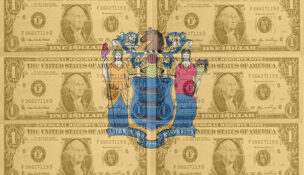
Gov. Phil Murphy delivered his second inaugural address on Jan. 18 with the state heading toward a third year of the COVID-19 pandemic and with business leaders and residents expressing frustration about the measures public health officials believe are necessary to end the crisis. The governor begins his second term with New Jerseyans also seething over more traditional concerns – namely, cost of living and doing business here. Murphy tried to make it clear that he understands that widespread anxiety and consternation.
“Our job is to make living, working, and raising a family in New Jersey secure again for every one of the 9.3 million members of our extended family,” Murphy said during his speech at the Trenton War Memorial. “It is our duty to ensure a recovery from COVID that reaches far and wide to include every New Jerseyan, and to set them alongside us on the path forward,” he continued. “And it is our duty to get the American Dream working for everyone, as well.”
Property taxes and the high cost of living have vexed New Jerseyans for a long time. A November poll from the Eagleton Institute at Rutgers University found the topic has been their main concern for the past five decades. Murphy and other top political leaders have said they want to address the issues but have offered no concrete plans.
The governor vowed to not raise taxes in his second term, which could hinder efforts generate revenue especially in the likely event of a future economic downturn. But he did offer an outline of how state officials can help.
“Though property taxes are not set by the state – by either me or the Legislature – the decisions and investments we make directly impact their trajectory,” he said. “Every dollar of new state funding for our schools and communities, for local roads and libraries, and for countless other areas, is a dollar that stays in your pocket as a property taxpayer.”
Democratic leadership has slowly moved to pursue affordability as well – with both Assembly Speaker Craig Coughlin, D-19th District, and newly installed Senate President Nicholas Scutari, D-22nd District, citing it as a priority.
“Affordability, in my opinion, is the number one issue facing New Jersey,” Scutari told the 40-member Senate on Jan. 11 right after being sworn in as Senate President. “We need to work on the affordability for people to live, work and raise a family here.”
Coughlin meanwhile told the 120-member state Assembly that same day that “[p]eople told us they feel vulnerable and often helpless in the turbulent and ever-changing economy,”
“New Jersey told us that government doesn’t appreciate the line between well-off and struggling that so many families juggle with each day.”
To Republican leaders – like state Sen. Steven Oroho, R-24th District – the change in rhetoric means New Jersey could finally be headed in the right direction.
“After the November election, the governor and legislative leaders of both parties said addressing affordability would be a priority,” he said on Jan. 18. “After all that talk, it’s time to show people some real action.”
Gop Proposals
For example, Oroho said, the state could create a charitable tax deduction. And the state could take on New York’s taxation of workers telecommuting from New Jersey, he added.
Oroho said that state leadership could also rein in the public worker pension and health care costs – something touted by Sweeney as part of his “Path to Progress” proposals. And the state could clamp down on public worker paid sick leave in order to put an end to “massive retirement payouts that blow-up municipal budgets,” typically from career public workers who cash in their unused sick days upon their retirement.
“Our job is to make living, working, and raising a family in New Jersey secure again for every one of the 9.3 million members of our extended family.”
– Gov. Phil Murphy
One proposal floated by Murphy’s GOP challenger Jack Ciattarelli calls for changing the school funding formula, and Oroho supported such a measure, saying it would “make the distribution of billions of state aid more equitable. Skeptics warn that such a move could be challenged in court.
Oroho also suggested that the state could use any of its $6.4 billion in COVID-19 relief funds from the Biden administration to fill in the state’s pandemic-drained unemployment trust fund, rather than rely on business tax increases to fill in those holes.
Business groups have been widely supportive of such a proposal, but leaders like Sweeney said in late November that even the entire $6.4 billion pot of money “wouldn’t have been enough” to fill that hole.
During his state of the state message, Murphy cited one metric that suggested an economic rebound: A federal analysis of New Jersey’s quarterly gross domestic product placed the state in the top five for growth compared to the same quarter last year.
And many new industries have set their sights on New Jersey ever since Murphy took office, he said.
The governor touted his business track record, saying industry is booming in sectors such as clean energy and offshore wind, life sciences and medicine, film and television productions, cannabusiness, and online gaming and sports betting, “which we now dominate.”
“We’re going to continue growing the innovation economy that will power our future and make us a model for the nation and the world. … Over the past four years, I have attended many groundbreakings … In the next four, I look forward to many more ribbon-cuttings.”
But going into his second term the governor faces a state with some of the nation’s highest taxes, including on property, income and corporations. In addition, New Jersey’s unemployment rate is 6.6%, higher than the national average, while job recovery has lagged. And though the state’s population grew over the last decade, it fell in 2020 and 2021 during the pandemic.
Public worker pensions are unfunded by about $100 billion according to some estimates, and was the source of a combined 11 credit downgrades for the state between 2010 and 2018, when former Gov. Chris Christie was in office. In 2011, Christie opted to suspend cost-of-living-adjustments banked into the pension plan, which was upheld in court in 2016.
The state also has one of the nation’s largest credit card bills at over $44 billion.
New Jersey Business & Industry Association President and Chief Executive Officer Michele Siekerka said earlier in January that the state still needs a “proactive and comprehensive plan to help New Jersey businesses and the economy, rather than the reactive approach and continuation of the policies that harm our business community.”
Tom Bracken, president and CEO of the New Jersey Chamber of Commerce, offered three potential solutions. First, the state can add funds to the Return & Earn program, under which the state provides subsidies for $500 hiring bonuses and for up to $10,000 in training wages for new hires entering a different industry.
New Jersey can also provide more working capital to businesses “still suffering from the pandemic-fueled recession,” Bracken continued earlier this month. And the state can use its own coffers to refill the state’s depleted unemployment trust fund rather than punt the responsibility to businesses in the form of tax increases that went into effect last year.
Many of these policy priorities could come out of the state’s ARP dollars, Bracken suggested, but groups and interests across the state want the money used to fund their policy priorities. A special legislative committee formed last year must approve major any expenditures of ARP dollars.
Murphy cited his successful pursuit of a millionaire’s tax “that asks those at the top to pay their fair share.” And he touted tax cuts for lower-and-middle-class residents and the state’s move toward a $15 minimum wage as evidence that the state was creating greater economic equity. Murphy said he plans seek a new prescription drug affordability bill.
“We are lifting up working families and strengthening the middle class while ensuring those at the top do and pay their fair share,” Murphy said.
Progressive groups agreed: the higher taxes shifted the burden from families in need to those on top.
“We’re already seeing lawmakers using ‘affordability’ framing to push for policies that either explicitly benefit wealthy residents … or explicitly harm residents who we should be helping,” said Peter Chen, a policy analyst with the progressive think tank New Jersey Policy Perspective.
Chen pointed to laws that allow “wealthy homeowners” to escape the the Trump-era $10,000 federal cap on state and local property tax deductions. And Chen noted proposals to cut to public worker retirement and health benefits.
“If a proposed policy largely benefits the already-wealthy and worsens inequality, it is not truly making the state more affordable,” Chen continued. “The focus of affordability measures should be easing costs for the low- and moderate-income people who need help the most.”