Sign In
Upcoming Event
 Free Newsletter


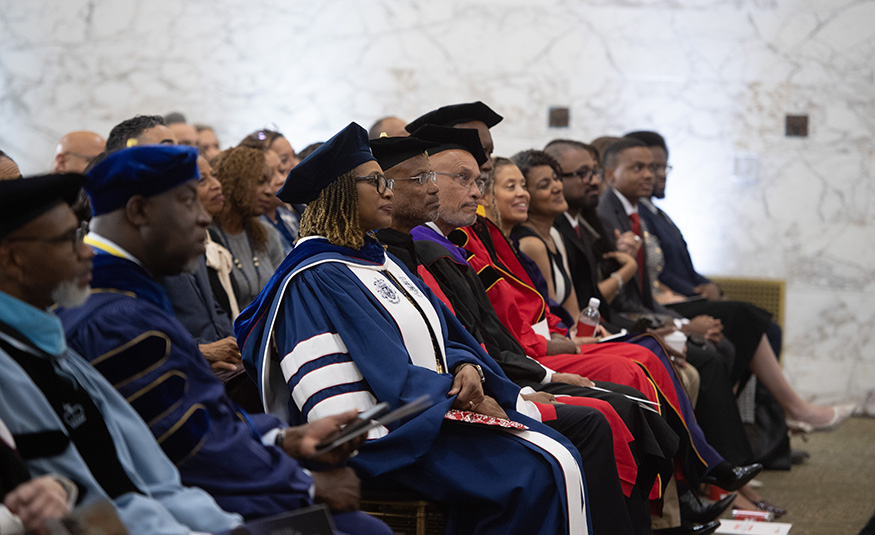
Rutgers University inaugurated its President William Tate IV during a Nov. 7, 2025, ceremony at Ruth Bader Ginsburg Hall at Rutgers-Newark. - PROVIDED BY RUTGERS UNIVERSITY
Rutgers University inaugurated its President William Tate IV during a Nov. 7, 2025, ceremony at Ruth Bader Ginsburg Hall at Rutgers-Newark. - PROVIDED BY RUTGERS UNIVERSITY
Rutgers inaugurates Tate as 22nd university president
Matthew Fazelpoor//November 10, 2025//


 Listen to this article
The basics:
- William Tate IV officially sworn in as Rutgers‘ 22nd university president
- Launch of the Edge Fund to provide scholarships for arts, science, sports, tech students
- Ceremony included Count Basie Orchestra, Rutgers Glee Club, student speakers
- University leaders praised Tate’s transformative vision and LSU track record
Rutgers University officially inaugurated its new president, William Tate IV, during a Nov. 7 ceremony at Ruth Bader Ginsburg Hall at Rutgers-Newark.
Tate serves as the 22nd president in Rutgers’ history. He previously held the same role at Louisiana State University, until his hiring by RU in May. Tate officially succeeded former President Jonathan Holloway July 1.
In his speech, Tate said he is committed to investing in opportunity – foremost for students. He announced the establishment of the Edge Fund for scholarships. The initiative aims to celebrate and support the next generation of thinkers and creators who achieve innovations in the arts, sports, science and technology.
“In an era defined by speed, spectacle and performative acts, we have a moment to demonstrate our commitment to opportunity,” said Tate. “It exists in every ZIP code and income bracket in New Jersey. It is limited only by our collective focus and imagination.”
Building future leaders
He says that when it comes to students, excellence can be found everywhere. “Finding it – and letting it flourish – drives our state, our university, our communities,” said Tate.
He stressed the Edge Fund will launch for students whose brilliance crosses areas – artists, scientists, coders, writers and competitors in nonrevenue sports. He says theses students will bring imagination, integrity, prowess and impact to Rutgers.
“These are the future inductees to the New Jersey Hall of Fame,” noted Tate.
The inauguration ceremony had an invite-only audience of about 300 people.
Key event details:
- Led by Musical Director Scotty Barnhart, the Count Basie Orchestra performed and played the “National Anthem” sung by Carmen Bradford
- Pastor René Brown of Mount Zion First Baptist Church, Baton Rouge, La., delivered an invocation
- Student government leaders from Newark, New Brunswick and Camden spoke at the ceremony
- The Rutgers University Glee Club performed the Alma Mater
Watch Rutgers’ President William Tate IV’s inauguration here:
Rutgers Board of Governors Chair Amy Towers described the inauguration as the start of a new era.

“Dr. Tate brings to Rutgers a deep commitment to scholarship, a drive for innovation, an absolute passion for life, and a deep belief that our university’s greatest strength is our people – our faculty, staff, students and alumni who all embody the Rutgers’ spirit of resilience and possibility,” said Towers, who co-chaired the presidential search committee. “Today marks the beginning of a new era for Rutgers. An era that honors our vibrant past while embracing the opportunities of the future with confidence and courage, energy and excitement.”
“Our charge was to identify a transformative and visionary leader, one whose experience, integrity and character would reflect Rutgers’ core values, and whose presence would inspire a genuine sense of connection and purpose on all campuses,” said Lucille Foster, Rutgers University Senate chair; member, Rutgers presidential search committee. “On paper, he was impressive. In person, he surpassed every expectation.”
Renaissance man
Rutgers board of trustees Chair Kenneth Johnson said that he can say with complete confidence and conviction that Tate is the right person for this moment.
“He is the person that will push Rutgers forward on its path to win, to grow as a premier public research institution, and he will leverage and amplify the many strengths of the university, including faculty, students, staff and alumni to get us there,” said Johnson. “I can’t wait to see how President Tate will bring us to the future as we travel that path together.”
James Williams was the featured speaker. Williams is co-managing partner of Chehardy + Sherman + Williams as well as a member of the LSU board of supervisors. He spoke about the impact Tate had leading LSU in his four years there.
“Bill led what can only be described as an LSU renaissance. During his presidency, we experienced a 50% increase in research expenditures. We had four consecutive years of record freshman classes,” said Williams, adding, “We received the largest gift—by more than double—in the history of the university. We grew online enrollments by 82%, had record appropriations and six athletic national championships.
“Bill Tate showed us what a president should be.”
‘New Jersey’s gain’
Williams said Tate’s time at LSU came to a close sooner than any of them had hoped.
“Our loss is New Jersey’s gain, as Bill seized the opportunity presented by a new calling, which gives him a better platform to use his time and talents to change the world,” said Williams.
As he closed his speech, Tate warned of a cautionary tale about the fate of our communities if higher education institutions, such as Rutgers, were to disappear. That of course comes against the backdrop of the slew of challenges facing higher education.