Sign In
Upcoming Event
 Free Newsletter

Clio Snacks thrives in Middlesex County innovation ecosystem (updated)
Kimberly Redmond//June 29, 2026//
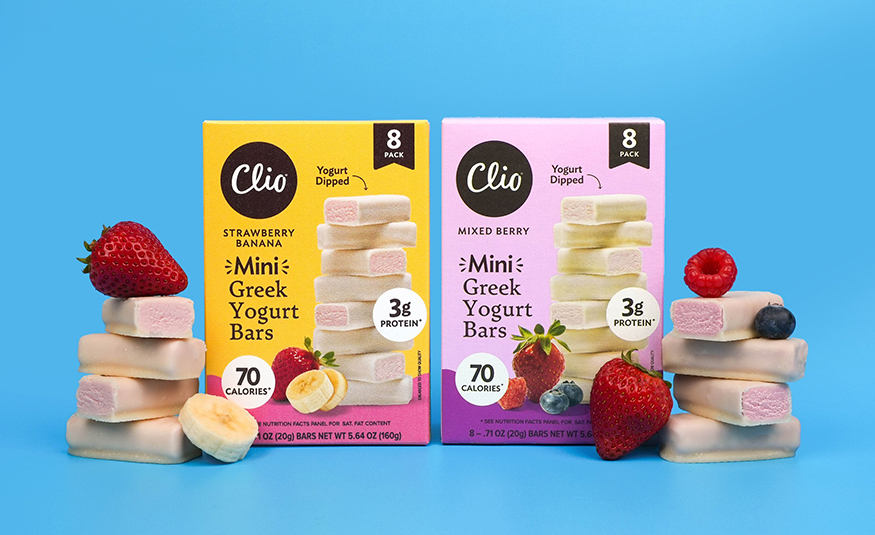
In 2024, Clio Snacks expanded its portfolio with Mini Greek Yogurt Bars. - PROVIDED BY CLIO SNACKS
In 2024, Clio Snacks expanded its portfolio with Mini Greek Yogurt Bars. - PROVIDED BY CLIO SNACKS
Clio Snacks thrives in Middlesex County innovation ecosystem (updated)
Kimberly Redmond//June 29, 2026//


)

The basics:
- Clio Snacks projects $120M in annual revenue, up from $85M
- Middlesex County company produces up to 185M yogurt bars annually
- Expansion driven by retail growth, innovation, national distribution
- CEO targets $300M+ valuation through U.S., international growth
As the snack industry’s first and only refrigerated yogurt bar, Clio Snacks is shaking up the market with its blend of creamy Greek yogurt and decadent dark chocolate coating. With a retail footprint of thousands of stores across the U.S., including major chains like ShopRite, Walmart, Target, Whole Foods Market and Sam’s Club, the Piscataway-based brand is on track to hit $120 million in annual revenue. That’s up from $85 million in 2025.
The company is one of several food industry businesses based in Middlesex County, which has become a hub for flavors and fragrances. The ecosystem also includes food science researchers at Rutgers University.
From its 86,000-square-foot base at Piscataway Corporate Center, Clio is working to increase production from 140 million bars last year to 185 million this year. Within the next five years, Clio CEO John McGuckin believes the brand can become a $300 million-plus business through a combination of deeper U.S. penetration and international expansion.
How it started
That’s not bad for a company that grew out of a chance kitchen discovery involving thickened Greek yogurt and chocolate about a decade ago in Union County.
Founded by Ukrainian immigrant Sergey Konchakovskiy, Clio was inspired by his childhood memories of syrok – a popular chocolate-covered soft cheese bar in Eastern Europe. After moving to the U.S. and working in finance, Konchakovskiy set out to whip up a healthier, more convenient version of the treat.
After finding out that strained Greek yogurt left in the refrigerator takes on a rich, cheesecake-like texture, he began experimenting with molding it into bars dipped in chocolate.
In its early days, the production process involved using restored Soviet-era equipment by hand in a rented garage. Clio introduced its products through small shops, offering free samples to gather public feedback.
Thanks to its unique taste and texture, the product quickly gained traction with consumers and attracted more retail partners.
By 2019, Clio signed an industrial lease for a 20,300-square-foot space on Ethel Road to expand its manufacturing and distribution operations. In 2021, it grew its presence at Piscataway Corporate Center with an additional lease of an adjacent 13,000 square feet and another 20,000 square feet in a building next door.
Shifting snack preferences
Valued at over $292 billion, and projected to surpass $358 billion by 2031, the global snack industry is a massive, booming sector.
The market is currently undergoing a rapid shift toward high protein, clean label, and sustainable options due to rising consumer demand for active snacking and convenience.
And Clio is poised to meet those needs – but in a way that is “permissibly indulgent,” McGuckin said. Along with an irresistible cheesecake-like taste and texture, Clio’s snacks offer the benefits of Greek yogurt, such as protein and probiotics, in a bar that’s perfect for grab-and-go snacking.

Besides its original-sized bars in flavors like chocolate, strawberry, vanilla and limited-edition pina colada, the lineup includes:
- 70 calorie mini bites in salted caramel, raspberry, cookies & cream, strawberry, vanilla and cookie dough with 4 grams of protein
- Zero sugar, 100 calorie bars in mixed berry and vanilla with 7 grams of protein
- Yogurt dipped bites in strawberry banana with 3 grams of protein
In addition to thousands of stores across the country, Clio’s offerings are found on its website. There, customers can build their own bundle of four, five or six boxes.
McGuckin shared, “We’re growing at 35% year over year … And, we’re humble, hungry and appreciate all the support that we’re getting from our retail customers, but we all know that we have a long way to go.”
“The biggest focus for our team is to develop our business in the United States, get the right footprint in the refrigerated case in between desserts and yogurt and create a category destination for refrigerated bars,” he said.
‘A product and a dream’

After bringing on McGuckin in 2021 to scale Clio, the brand has spent the past few years retooling and realigning product formats to better support an omnichannel growth strategy.
The effort to build market share has also included upgrades to Clio’s manufacturing facilities as well as continued product innovations that further the company’s position as a category leader in the refrigerated bar segment.
A 25-year-plus veteran of the consumer-packaged goods industry, McGuckin has deep experience scaling refrigerated and better-for-you brands into mainstream retail channels.
Before Clio, he was chief sales officer at Lakeview Farms, a manufacturer of fresh dips, desserts and specialty products. Prior to that, he held chief executive officer posts at hummus producer Tribe Mediterranean Foods in Massachusetts and sauce maker Maya Kaimal Fine Indian Foods in New York.
His resume also includes an eight-and-a-half-year stint as executive vice president of sales for North America at Sabra Dipping Co. in New York.
“When I joined the company [Clio], it was in jeopardy and it was cash poor. We had lost the CFO, the COO and the head of sales the week before I started,” he said. “We lost all this support staff. And what I walked into was Sergey Konchakovskiy, a product and a dream, but then also meeting the board members … who shared with me their willingness to continue to help to invest and build the company because everybody believed in Sergey’s dream.”
In addition to expanding its hub in Piscataway, the company’s workforce has jumped from 50 employees to about 170, according to McGuckin.
We’re growing at 35% year over year … And, we’re humble, hungry and appreciate all the support that we’re getting from our retail customers, but we all know that we have a long way to go.
– John McGuckin, Clio Snacks CEO
“As the company’s grown, the infrastructure has grown in step – not ahead of it – but in step with it. And, that’s been wonderful to see,” he said.
McGuckin went on, “As we look at our five-year plan, we feel like until 2032 we could continue to manufacture onsite and probably grow our business by two-and-a-half times, should the consumer trends continue and should our distribution continue to grow as we close white space and build household penetration and awareness.”
Singled out
When McGuckin arrived in 2021, Clio generated roughly $25 million in annual revenue, with its products primarily sold as individual 1.75-ounce bars priced at about $1.25 each.

McGuckin described it as “the biggest issue that the company faced at the time.”
“All we were selling were these single bars. And today, of course, we still sell the single bars, but we sell them to convenience stores and airports and colleges, universities through our foodservice channel,” he said.
In reevaluating Clio’s approach, McGuckin opted to step up its retail and club strategy. Clio then began offering a four-pack format and eight-count boxes of 0.78-oz minis for grocery priced between $4.99 and $6.99.
“We were able to generate not only consumer interest because people wanted more, but very importantly, we’re able to get those invoices from $1,000 to $7,000 and so on. So, that helped to bring cash into the company,” he said.
“And then because we started to see some immediate growth, we were able to attract investors a couple years later to do a raise and it was very important at the time,” he said, noting that outside capital has enabled distribution growth, manufacturing facility enhancements and new product launches.
Gaining ground
During a funding round in 2022, Clio raised about $18 million. Backers included long-term partner Alliance Consumer Growth, professional tennis player Maria Sharapova and NBA player Jayson Tatum.
Two years before that, Clio announced the close of an $8 million funding round led by ACG. “Armed with that and moving past the cash issues, we were beginning to become a profitable company. I think we grew our margins from some ridiculous number to now well over 40 [percent] and negative EBITDA to now double-digit EBITDA as we surpass $100 million in revenue,” McGuckin said.
After the company began gaining ground in grocery, McGuckin turned his attention to opportunities like the foodservice space. To lead those efforts, he tapped Sabra’s former national director of foodservice sales, Scott Thewes, as Clio’s vice president of sales in foodservice, convenience & vending.
Shortly after onboarding with Dot Foods and securing key distributor relationships with companies such as Aramark and Compass Group, Clio expanded into the college and university channel to hit 250-plus campuses across the U.S.
Not only viable, ‘but essential’
Clio then leveraged that sales data to unlock additional nontraditional retail segments, like Hudson News stands at airports nationwide. The company has also deepened its presence in the convenience store channel through partnerships with Sheetz, Wawa, QuikTrip and 7-Eleven.
McGuckin explained, “We’ve also grown quickly in c-stores. We went from nothing in convenience stores, college, universities and airports three years ago to now we have 19,000 c-stores.”
One of the most challenging aspects overall was “convincing the trade that this form of snack was not only viable, but essential for distribution,” he explained.
“Thankfully, as we look at continued velocity growth, distribution growth, there’s been a buy-in. So, we are now nationally distributed — you’ll find us in multi-channel, so club, natural foods and mass merchandisers like Target and Walmart, and almost every single retailer across the country,” he said.
How it’s going
Though Clio now averages about 2.3 SKUs per store nationwide, the company is working to increase that to roughly six to seven items per location for a stronger shelf presence, according to McGuckin. “The growth opportunity there to double, triple, quadruple the size of the business is very significant,” he said.
As a brand at the intersection of yogurt and refrigerated snacking, McGuckin sees plenty of opportunities to innovate. He feels “there are many, many places that we can go even in just the refrigerated case” by “not leaving the guardrails of handheld and by making sure that our number one priority is flavor delight while maintaining sort of this permissibly indulgent umbrella.”
For instance, Clio is currently working on two new product lines: a kid-focused range and a higher protein bar with added texture, according to McGuckin. The children’s-friendly line will hit Target this summer before a larger rollout to other retailers, such as Sam’s Club, Stop & Shop and Whole Foods Market, he said.
‘Cooler’ snacking
The new offering includes Greek yogurt bars in flavors like drizzled strawberry banana milkshake and strawberry dream. Along with calcium, vitamin D, 5 grams of protein and gut-friendly probiotics, the product aims to make snack time “cooler” by including jokes on every wrapper of the five-count box.
More from
Middlesex County Focus
- Middlesex County drives innovation with major investments
- Centrally located, Middlesex County emerges as industrial beacon
“It’s slightly different packaging and the product is a little bit different. Instead of being chocolate coated, its yogurt coated with various colors,” he said. “And they’re packed with protein just like our Clio bars are, but there’s also a drizzle chocolate coating on it.”
“It is line priced with the rest of the brand so that we can help to create our footprint on shelf and promote the product sort of together without either one losing their identity and focus,” he said.
Clio decided to push into the sizable kids’ snack category after hearing feedback from a few customers during a product expo a few years ago, according to McGuckin. “We think we’ve got ages 1 to 5 kind of covered. But there’s a gap between ages 5 and 12. So, that really became our focus as we developed this product line,” he said.
“The interesting thing is that yogurt is a $12 billion industry and kids is $1 billion. So, we think we can make a real mark because of the fact that it’s only a billion dollars. I mean, if we can capture just 5% of that category, it becomes a very significant business for us,” he said.
Focus on protein, fiber – and flavor
Amid growing consumer focus on protein and fiber driven in part by GLP-1 dietary drug trends, Clio hopes to turn out a bar that increases both nutrients but maintains taste, according to McGuckin.
He went on, “You will not find that Clio will sacrifice flavor for protein or flavor for calories. The number one non-negotiable for us is flavor delivery and that’s going to remain our primary goal. If I tell you that we’re working on a project where we can go to 12 grams of protein or 18 grams of protein, if the 12 grams of protein tastes better, that’s where we’ll be. If we can get 15 and we don’t sacrifice taste, that’s where we’ll be. If it’s 18 and we even feel the slight mouthfeel differential, we won’t go there. Flavor is king for us.”
“I think that’s our stock and trade, is being a brand that can play on both sides of the field. We can deliver a better-for-you permissibly indulgent product that tastes awesome. So that’s exactly where we want to be. We don’t need to be the healthiest product on the shelf. We just need to be better than most, but we need to be the best tasting product on the shelf,” he said.

Oh, Canada
Clio is already gaining traction in Canada via distribution at about 450 Walmart stores.
“The yogurt category in Canada is three times bigger per capita than it is in the United States. It’s a $3 billion category in Canada,” McGuckin said. “Canada plays more like European markets with yogurt, so there’s a tremendous opportunity for us to grow there because you’re dealing with, I think, a more health-conscious demographic to begin with. And I also think that a lot of their epicurean instincts lean more toward Europe than they necessarily do in the United States,” he said. “The opportunity to expand in Canada is great. We’re hopeful that things are going to break our way in Canada very quickly, especially with Walmart’s success up there.”
As for overseas expansion, McGuckin said “there’s no doubt that there’s an opportunity.” But, he said, “what would have to happen in that regard is we’d have to either build a facility or have a partner. Because with a fresh product, you wouldn’t want to be in a position where you’re shipping from the U.S.”
The right team
Though his resume includes positions at some major consumer packaged goods brands, McGuckin feels his niche has “always been working with entrepreneurs.” He cited his time working under Sabra founder Yehuda Pearl as an experience where he “learned a ton” while scaling “something that was so meaningful to the American palette.”
“Yehuda designed the Sabra hummus with the window and the garnish, which completely revolutionized the category. I joined Sabra in 2007, and the brand was about $12 million in sales. When I left [in 2014], it was approaching $500 million in sales,” he said.
“It really solidified me as a person who enjoys working with founders, integrating the company, attracting the right talent, building the right processes that can generate resounding success,” he said.
“So, now here at Clio, working with Sergey Konchakovskiy, our founder, we’re seeing the same kind of scaling opportunity that we saw at Sabra,” he said. “When I began just four years ago, the company was doing about $25 million in sales, and we’ll do north of $100 million this year as we also grow margins in EBITDA and continue to innovate and attract really good people to the organization.”
“Of course, there are challenges and so much of it is shaped around the collegiality in your company and the collaboration between sales, operations and finance. So, we have a highly disciplined … sales and operations forecast process. And because we ship to our customers with two weeks’ lead time, you can imagine the work that has to be done to make sure that we have the right product staged, the right supplies in place and all the right resources to make sure that we don’t disappoint our customers,” McGuckin said. “We’re dealing right now with a 98% service level, which for our industry is outstanding.”
Yogurt culture
McGuckin has prioritized building a team with market expertise and understanding of evolving consumer preferences. He noted that the company’s hiring strategy has focused not only on attracting talent with deep industry expertise and a strong understanding of evolving consumer preferences, but also on bringing in employees who embrace Clio’s culture and long-term vision.
“It’s all about the team and the culture, making sure that you have the right team and having that environment where there’s a tremendous amount of trust where people feel comfortable challenging one another,” he said. “That’s just helped us to take off like a rocket ship. We have a great team, great product, great culture, and the results sort of speak for themselves. It’s a long way to go. But, growing the business four or five times in four years is certainly no joke,” he said.
[Having the right team and culture has] just helped us to take off like a rocket ship.
– John McGuckin, Clio Snacks CEO
Middlesex County influence
And while Clio was born in Union County, McGuckin credits Middlesex County as the place that has truly influenced the company’s ability to grow. “It is a great ecosystem that is very supportive of its businesses,” he said. “It’s been great working with Middlesex County. They are big supporter and we feel blessed to be here.”
“The location is ideal. I mean, you’re four hours to Boston and four hours to Washington, D.C., and right in between New York and Philadelphia. So, you have the ports, you have the airports, you have the highway system,” he said.
“And, you have a diversified and very educated workforce. Middlesex County has almost the highest rated education level in terms of workforce,” he said. Clio also has students from Rutgers University who intern during the summer. And Clio Research & Development Director Valentina Visci recently began working with food innovation centers at Rutgers and Penn State and on developing products, according to McGuckin.
“This is a relationship that began relatively recently. They’re working on not just flavor innovation but continuously finding ways to improve the existing product,” he said.
Board support
McGuckin also emphasized the importance of having a supportive board. “The other part is a founder willing to hand the reins over to a certain degree. It’s his baby, right? He built this thing. So, gaining his confidence to the extent that he hands you the reins and allows you to integrate his baby toward successful outcomes. That’s another important aspect of our success. So, hats off to Sergei and to our leadership team and all the people at Clio who work every day to make this happen,” he said.
Though Konchakovskiy stepped down in 2021, he moved on to serve as executive chairman of the board. At the time, Konchakovskiy said, “It’s been both a once-in-a-lifetime opportunity and dream to build Clio from scratch and lead us through the past six years. As Clio continues to grow so quickly, I’m honored to have John join us as CEO. With his unparalleled track record building some of the fastest-growing CPG brands to mainstream recognition, he has a powerful, forward-thinking vision for Clio’s future.”
Clio’s momentum under McGuckin has not gone unnoticed. In June, he was among 11 regional winners from New Jersey for EY’s 2026 Entrepreneur of the Year Award. McGuckin said he was “extremely honored” to be recognized by EY and “to be included alongside so many outstanding entrepreneurs and business leaders from across the state.”
“Throughout my career, I’ve had the privilege of working alongside founders and entrepreneurs, helping them bring their visions to life and scale their businesses. That’s one of the reasons this recognition is especially meaningful to me,” McGuckin said.
“At Clio, I’ve had the opportunity to build upon the vision our founder, Sergey Konchakovskiy, established and help lead the brand through its next phase of growth. While this recognition bears my name, it reflects the momentum of Clio Snacks and the incredible team behind the brand. Over the past several years, we’ve built on a strong foundation to expand our reach, bring innovative products to consumers nationwide, and continue growing a company we’re all proud to be a part of,” he said.
Editor’s note: This story was updated at 12:48 p.m. June 29, 2026, to note that Clio products can be found in Sam’s Club, as well as the other retailers listed, but not Costco as previously mentioned.