Sign In
Upcoming Event
 Free Newsletter

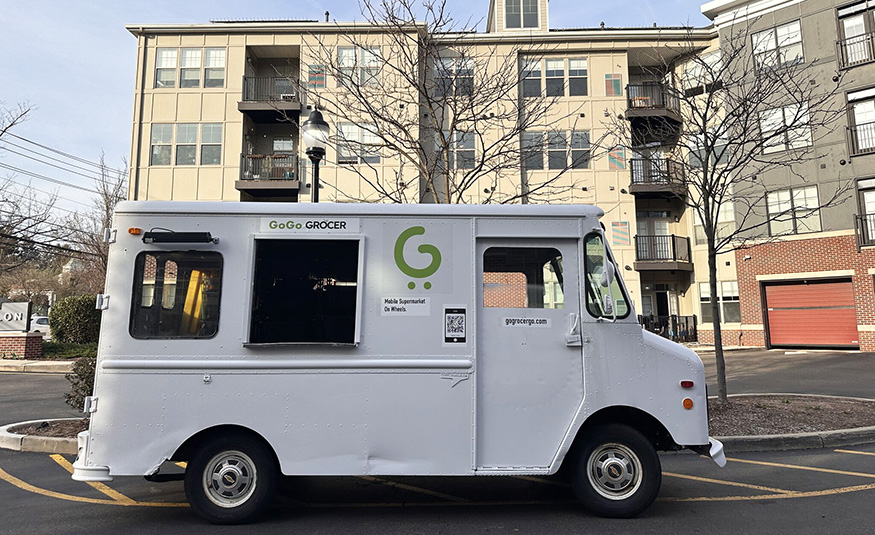
Founded in 2025, Cranford-based Gogo Grocer brings fresh produce, meats, dairy and household essentials directly to where people live through an innovative mobile storefront model. - PROVIDED BY GOGO GROCER
Founded in 2025, Cranford-based Gogo Grocer brings fresh produce, meats, dairy and household essentials directly to where people live through an innovative mobile storefront model. - PROVIDED BY GOGO GROCER
Gogo Grocer brings mobile grocery service to NJ’s food deserts
Kimberly Redmond//May 4, 2026//


 Listen to this article
The basics:
- Gogo Grocer startup delivers groceries via mobile storefront to NJ communities
- Targets food deserts and underserved populations
- Partners with local supermarkets and SNAP/EBT providers
- Pilot program launched at Maplewood residential property
What if getting groceries felt a little more like waiting for the ice cream truck?
That’s the idea behind a Cranford-based startup that brings fresh produce, meats, dairy and household essentials directly to where people live through an innovative mobile storefront model.
Founded in 2025, Gogo Grocer partners with local supermarkets to make weekly stops at apartment complexes, gated communities, senior housing and underserved neighborhoods, helping residents skip a trip to the store. By working with SNAP/EBT-approved supermarkets and local merchants, Gogo Grocer aims to make healthy, affordable options more accessible while helping its retail partners generate additional revenue.
For Gogo Grocer co-founder and CEO Chrys Ma’ach Camacho, the concept aims to bridge the last-mile gap in food accessibility. After earning a bachelor’s degree in mechanical engineering from New Jersey Institute of Technology, Camacho has focused his career on showing how thoughtful design can drive both access and sustainability.
With a background in operations, construction management and community-based development, Camacho has led tech initiatives from concept to launch across startups and enterprise environments. For instance, while at NJIT Camacho worked with four colleagues to develop a venture focused on drone-based environmental solutions, such as a system that deploys biodegradable seed capsules for aerial reforestation and land restoration.
Paratrees Technology raised about $975,000 in funding to support research and development. Camacho also earned an Edison Patent Award from the Research & Development Council of New Jersey in recognition of the innovation.
“We ended up licensing the software end of the technology for a few years … and then we moved onto other things after that,” he said.
Problem, solution
Camacho came up with the idea for Gogo Grocer about four years ago when he was working as an embedded systems engineer and program manager for MIIST Therapeutics in San Francisco.
“And one particular day, I remember just wanting to just go grocery shopping and there were no grocery stores that were of walkable distance. It was maybe 20 to 25 minutes for the closest one. And I think that’s when I realized the lack of grocery stores. There were tons of food, but not healthy options. And Uber Eats and Instacart — those were the only options if you really wanted to get groceries without driving there or taking public transportation,” he said.
Camacho said he designed the Gogo Grocer to “actually fix the problem” because third-party delivery platforms “only address one side of the issue.”
“I wanted to look at the whole entire supply chain and the market; and understand why food deserts even exist. And it really starts with understanding why supermarket store owners have a hard time expanding to new locations and just running a supermarket, as well, because of expenses associated with it,” he said.
Food deserts
Camacho also examined what kinds of issues consumers face when it comes to buying groceries, such as transportation barriers or limited options for stores.
In New Jersey, more than 1.3 million residents live in the roughly 50 state-designated communities that qualify as “food deserts” — areas that lack access to nutritious, fresh, affordable food. An additional 1.1 million individuals are considered food insecure, the Community Food Bank of New Jersey reported.
Nationally, an estimated 19 million people live in food deserts. Meanwhile, about 47 million Americans experience food insecurity each year, according to the U.S. Department of Agriculture.
Camacho said, “Typically, you find this in more urban communities where there’s tons of convenience stores that sell products at just about the same price as you would find in the traditional supermarkets. So, you’re paying relatively the same price for worse food. I wanted to figure out a way to help supermarkets while making food access more available. And that’s exactly what we ended up doing with Gogo Grocer.”
Road trip
Because Gogo Grocer brings a rotating selection of fresh and culturally relevant products from local merchants directly into communities, the service eliminates the need for residents – particularly seniors and those in food deserts – to travel long distances for groceries.

He noted that there’s no membership fees required for residents who want to shop using Gogo Grocer and no cost for property managers to bring the service onsite. Communities only need to provide a parking space and permission for Gogo Grocer to promote the service to residents.
Because the company handles everything from inventory to staffing to payment to logistics, it is a turnkey service that helps communities differentiate, improve resident satisfaction and elevate the overall experience without adding operational complexity.
The bus-style mobile market hit the road two months ago with weekly grocery stops at an AvalonBay Communities residential property in Maplewood. Before the official rollout at Avalon Maplewood, Gogo Grocer worked with the Jersey City Housing Authority to test a program using its vehicle and app to deliver donated groceries to seniors.
“Senior housing communities are a huge demographic that is very much impacted by having a hard time accessing food,” Camacho said. “So, we are looking to actually continue in the future to grow and provide our services with senior housing communities.”
The store that comes to you
As part of a pilot initiative with AvalonBay, Gogo Grocer parks a fully stocked truck at the Maplewood property every Tuesday from 5:30–7:30 p.m. The stop allows residents to shop without leaving their community or paying delivery fees. According to Camacho, the 225-unit property is home to about 600 people. He estimated that residents are a mix of “single people, couples and maybe a few families.”
If all goes well with the trial period, Camacho said, “Then we look at ways that we can expand our service and continue to improve on that service.” Along with expansion to other residential properties across Essex, Hudson and Union counties over the next six months, Gogo Grocer is interested in working with college campuses and corporate complexes.
“Imagine stepping outside of your office building to do a little light grocery shopping. You just saved yourself a trip from having to stop at an actual grocery store after work,” he said. “We’d like to be all over New Jersey if we can … there’s a lot of grounds and areas for us to be able to move into.”
‘We knew it was going to work’
Following Gogo Grocer’s arrival in Maplewood, Camacho said, “It felt really good and it validated a lot of the initial feelings that we had about the business plan. We knew it was going to work. We understood what we were getting into very well, and we just got a chance to see that play out in person.” Camacho added that he hopes to work with other developments within AvalonBay’s portfolio of 30 residential properties statewide, too.

AvalonBay Senior Director of Property Operations Evan Fox told NJBIZ there’s nothing formal in place with Gogo Grocer beyond the pilot program right now, but that the firm has enjoyed working with them.
“We’re always looking for ways to make everyday life a little easier and more enjoyable for our residents. Allowing mobile vendors like GogoGrocer to come on site is an example of resident-focused programming that makes a difference in our communities,” he explained.
“Residents appreciate having easy access to fresh food options right outside their door, so we enjoy working with a variety of mobile vendors and food trucks, as well as brick and mortar retailers in our mixed-use communities, to bring that kind of convenience directly to our residents,” he also said.
Catchy jingle
After Gogo Grocer’s January 2025 founding, the team spent several months developing an easy-to-use mobile app for shoppers and backend software tools to run the business. Though the startup envisions eventually having a specialized fleet, it needed to keep it cost effective for the first mobile store “because we’re operating on a tight budget,” Camacho explained. So, when it came time to purchase the first vehicle last fall, he said they opted for a modified ice cream truck.
“We wanted to keep the nostalgic feeling of when hear that jingle, you think ice cream. So, we have our own custom jingle on our vehicle. We’re really trying to push that jingle to correlate with, ‘Oh, do I need anything? What am I missing in my pantry?’” he explained.
Before beginning service in a community, Gogo Grocer works to develop a schedule that will best serve residents. Also, they do a dietary survey with partnering properties, according to Camacho. “The communities are the ones that are driving what is essentially going to end up on the vehicle. And then we work with the merchants to be able to curate those items to be sold in our vehicles,” he said.
See Gogo Grocer in action:
“In Maplewood, a lot of people wanted fresh fruits and vegetables, which to us was no surprise … And then your standard meat selections, chicken, beef and so on. We see a lot of trends toward healthy selections of product offerings,” Camacho said.
Currently, Gogo Grocer sources from:
- Mini Market Zoyatla: A Mexican supermarket in Roselle Park that provides fresh fruits and vegetables.
- Lakay Deli and Grocery: A Caribbean and African grocer in Irvington that supplies rice, grains, pasta, canned goods and pantry staples.
- Ahkils Autism Foundation: A South Brunswick nonprofit that employs people with autism to grow fresh spinach, mixed greens and microgreens.
Working with grocers
Gogo Grocer is also in talks with additional independent grocers about working together, according to Camacho.
For merchant partners, Gogo Grocer offers a distribution channel beyond their physical storefronts at a lower cost than delivery platforms.
The company charges merchant partners a commission well below the 25% to 30% that platforms such as Uber Eats and Instacart typically charge. They also receive monthly reports from Gogo Grocer on product performance to help guide inventory and restocking decisions.
When determining which retailers to team up with, Camacho said, “We start with quality. We look for grocery stores that sell fresh products because that’s the heart of what we’re trying to push as a company – trying to make healthy food accessible.”
“The second part is just understanding their business, what their goals are, what they’re looking to do, where they see themselves in three to five years from now,” he explained. “And, if they’re interested in expanding their service and reaching additional customers.”
We start with quality. We look for grocery stores that sell fresh products because that’s the heart of what we’re trying to push as a company – trying to make healthy food accessible.
– Chrys Ma’ach Camacho, Gogo Grocer co-founder and CEO
“Partnering with any additional third-party delivery apps such as Uber Eats, Instacart and so on is usually a good indicator that they’re trying to get additional customers and revenue. If that’s the case, we then approach them with our platform and our ability to actually grow their customer base and revenue,” Camacho explained.
“Many of them are interested in that and those that come on board and partner with us are seeing additional revenue being generated through our platform,” he said. “And then the beauty of it is that … their business is able to continue operating uninterrupted as they were doing prior to us. It requires minimal oversight on their end.”
Reliable revenue
“The biggest thing they get from us is reliable, recurrent revenues. We have data and know exactly how many customers we expect to turn out at each community we stop at and the sales that will be generated from that, so it’s a much more reliable, steady flow of income,” Camacho explained. “We’re getting to the point within two months, one of the supermarkets that we’ve partnered with, they’re going to be able to pay their store rent simply with our service.”
Another difference between Gogo Grocer and on-demand delivery platforms is that Camacho’s model is “not dependent on gig workers.”
“We have all our own in-house drivers and everything. We are a complementary service to the brick-and-mortar model, the supermarket, and an expansion to their retail store on wheels. We’re able to go places that a brick-and-mortar store can’t go,” he said.
What’s inside?
According to Camacho, the truck “holds a fair amount of food.”
“We don’t have an official limit as yet. We’ve been slowly increasing the capacity of certain products on our vehicle based on trends that we’re studying right now. But I think we try to carry about 15 items per product, and we have about maybe five products per category. So, it’s just your everyday pantry, staples, your basics,” he said.
Because Gogo Grocer is not actually making food, the company only needed a food transportation license to ensure goods are safely transported and stored before reaching customers, according to Camacho.
Residents can order groceries ahead of time via the Gogo Grocer app or shop directly at the truck once it arrives. “Some people like to see the items that they’re buying. We give them a very beautiful hybrid model that complements people who want to just use the digital tools and people who prefer more traditional experience,” Camacho said.
Customers pay the same prices they see advertised in stores. “We make money from the supermarkets. We do not pass a delivery fee onto the customers. If it’s $2.99 in the store, it’s $2.99 on our vehicle,” Camacho said.
Learn more about Gogo Grocer:
Mind the gap
According to Camacho, Gogo Grocer has already learned some lessons.
For one thing, customers want to see inside the truck and judge cleanliness and freshness before buying, making appearance just as important as product selection. People are willing to pay for groceries if they’re brought closer to them, as long as the food is handled safely. And strong demand for SNAP/EBT shows how essential payment accessibility is, especially for seniors and underserved residents.
Camacho said, “New Jersey is one of the most widely dense states in our country … and our infrastructure is really only efficient in certain parts of the state. So, you still have a lot of communities that the next closest supermarket 5 miles. And then you have inner city communities with hundreds of thousands of people living in one area and maybe a handful of supermarkets that are expected to meet this demand of all these residents, and oftentimes they can’t.
“And with the growing pressure of food access and the economic drivers behind supermarkets closing down and not expanding as much, I think there’s an opportunity to be able to fill in that gap,” he said.
“We’re not trying to get rid of supermarkets. We’re not a replacement for Uber Eats or Instacart because at the end of the day, if you want a hot meal, those are a really good option for people that want hot meals on demand,” Camacho continued. “But, if you want groceries on demand or a grocery service that’s very reliable, then Gogo Grocer might be an option for communities that have a lot of people living in close proximity to each other … and if gas prices keep going up, I’m pretty sure people would love to be able to save the trip to the grocery store.”
Start your engines
Camacho credits the drive of his team, which includes Chief Technology Officer Juan Alvarez and Director of Operations/co-founder Steevens Delices, as well as advisors. “We’re a small team of five. We have one driver right now, and everyone plays their part. So, we’re at that stage now that we have proven the business model works. We’ve proven that there is growth, and we’re ready now to see what the future holds for us,” he said. “We’re looking forward to expanding the team to try and get to 10 people by the end of this year.”
“I’d like this company to grow to hundreds of millions of dollars if I can. And I would like to see this in almost every community as an option for people to get access to their food. But most important, we’re kind of priming the company to be bought by Amazon or one of those larger companies because we just think it will fit very well in their portfolio. So, that’s kind of projections that we see. We really are building this company up to be able to be acquired by maybe a larger company that can take this nationwide,” he explained.
Camacho said it has taken “a lot of grit and hard work” to build Gogo Grocer while working a full-time job as a construction manager in Atlantic City. “Fundraising’s always something difficult or a challenge that a lot of people face, and I didn’t want that to be a reason why I couldn’t at least get this company started,” he said. “I think we’re at the point now where we’ve proven so much of the company’s concept that I think any investor now would be more than happy to flock toward Gogo Grocer and see what’s going on.”
Camacho said it can also be challenging to keep a team feeling upbeat while starting a business. “There were points where we’re like, ‘maybe we shouldn’t do this.’ And then someone luckily comes back and motivates the team with a fresh new look … You have your highs and you have your lows, but consistency definitely pays off,” he said.
Startup mentality
To be an entrepreneur, Camacho thinks “you have to be crazy.”
“There has to be something a little bit wrong with you to decide to start your own company, and especially if you’re going to do that off of just sweat equity at the beginning. I think you have to have a certain type of personality.”
“And then the second most important thing, at least with my second journey with my second startup, is that I’ve learned how to not listen to the millions of background noise. There’s a lot of people that are always going to be giving you their advice and telling you what you should probably do. You really have to just tune into your own frequency, find your own channel and just lock in on that only,” he said. “However, no one’s path is really the same as someone else’s. So, what might work for me may not work for you.”
Camacho added, “I’d also say feel fast. Try to feel as fast as you can. If something’s not working, don’t sit on it too long, try something new and keep doing that until you find something that works for you, honestly.”
Properties and merchants interested in teaming up with Gogo Grocer can reach out to the company at [email protected].