Sign In
 Free Newsletter

Legislation to address Disparity Study advances in Trenton
AACCNJ CEO Harmon: 'Intent and outcome are two different things'
Matthew Fazelpoor//September 23, 2024//

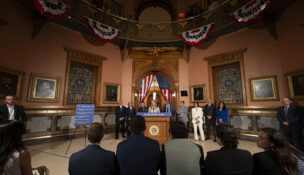
New Jersey assembly members and community leaders gather for the announcement of a legislative package designed to address the findings of the New Jersey Disparity Study released earlier this year. - PROVIDED BY NJ ASSEMBLY DEMOCRATS
New Jersey assembly members and community leaders gather for the announcement of a legislative package designed to address the findings of the New Jersey Disparity Study released earlier this year. - PROVIDED BY NJ ASSEMBLY DEMOCRATS
Legislation to address Disparity Study advances in Trenton
AACCNJ CEO Harmon: 'Intent and outcome are two different things'
Matthew Fazelpoor//September 23, 2024//


A package of legislation designed to address the findings of the New Jersey Disparity Study released earlier this year cleared an Assembly committee Monday.
Conducted by Mason Tillman and Associates, that study examined statewide contracting opportunities for Minority and Women-Owned (MWBE) businesses — finding statistically significant disparities.
“ … [W]hile we’ve made strides, much work remains to achieve true equity,” said Assemblywoman Shavonda Sumter, D-35th District, chair of the Legislative Black Caucus and of the Assembly Community Development and Women’s Affairs Committee. The latter held the Sept. 23 hearing in Trenton.

Ahead of the meeting, Sumter called a press conference with fellow lawmakers and stakeholders about the issue. She noted that Black-owned companies in New Jersey represent 9.19% of the available construction businesses, yet receive only a small fraction of the dollars in the construction contracts.
“This comprehensive package of bills is designed to directly address these disparities, ensuring that Minority and Women-Owned businesses not only have fair access to government contracts, but also the resources needed to compete and succeed,” said Sumter. “Our focus is on holding state agencies accountable, expanding opportunities, and fostering a truly inclusive and equitable economy that benefits every resident of New Jersey.”
Assemblyman Benjie Wimberly, D-35th District, co-chairs the Joint Committee on Economic Justice and Equal Employment Opportunity. He said lawmakers want to put policies in place to drive real, lasting change and benefit business owners, as well as the New Jersey economy for generations.

“Since the findings of the Disparity Study were released, we’ve met with many stakeholders, listened to their concerns, and now we are taking steps towards leveling the playing field,” said Wimberly.
The bills advanced Monday include:
- Assembly Bill 4487: Requires State Contract Mangers to monitor work conducted by subcontractors on State contracts.
- A4548: Provides corporate business tax and gross income tax credits for employers of certain persons with disabilities.
- A4586: Establishes Minority and Women-Owned Businesses State Contractor Remedies Act.
- A4648: Provides for state agencies to issue advanced payments to certified business enterprises awarded state contracts.
- A4719: Requires certain notifications to subcontractors listed on bid for state contract by prime contractor.
- A4720: Requires chief diversity officer in Department of Treasury and other state officers to conduct certain outreach events, training workshops, and educational programs for minority and women-owned businesses.
- A4721: Requires Department of Treasury to update New Jersey Disparity Study every five years.
- A4722: Requires state agencies to make good faith effort to increase awarding of contracts procured without advertisement to minority- and women-owned businesses.
- A4723: Modifies title and role of chief diversity officer; establishes New Jersey Office of Supplier Diversity and Business Opportunities.
- A4724: Establishes sheltered market program for certain business enterprises seeking state contracts.
- A4725: Requires state agencies to make good faith effort toward certain goals to use certified minority and women-owned businesses as prime contractors and subcontractors.
- A4744: Requires New Jersey Turnpike Authority, South Jersey Transportation Authority, New Jersey Economic Development Authority, Casino Reinvestment Development Authority, Port Authority of New York and New Jersey and Delaware River Port Authority to consider minorities and women when hiring or awarding contracts.
“These bills are a direct response to those concerns, and the wide range of sponsors on these bills – representing different communities and perspectives – demonstrates that this is a shared priority for all of us,” said Wimberly.
Getting on the same page
Among stakeholders who testified before the committee was John Harmon, founder, president and CEO of the African American Chamber of Commerce of New Jersey (AACCNJ). Harmon recently penned an op-ed, “Do Right By US,” calling for action from lawmakers and legislative leaders to address the Disparity Study’s findings.
He also criticized the inaction since the study’s January release. Harmon echoed those sentiments in a recent interview with NJBIZ.
“As the AACCNJ continues to advocate for a more transparent, accountable, and equitable public procurement process, we seek your help in bringing this desired outcome to fruition,” Harmon wrote in the Sept. 7 op-ed. “This is a defining moment in the history of our state and an opportunity to reconcile our mutual interests for the betterment of all of New Jersey.”

Harmon noted the AACCNJ’s efforts since the findings came out – meeting with leaders and stakeholders to share concerns and search for solutions to implement best practices that make the state a more competitive, inclusive and equitable environment in which to do business. Other efforts include establishing a task force to disseminate information about the study, and more.
“A lot of the recommendations that we have made have been largely ignored, unfortunately,” Harmon testified Monday. “But the hope is that after today, we can have a deeper engagement so we can get on the same page.
“We asked earlier for a moratorium on public contracting – with the hope of getting some consensus on the resetting of the procurement process here in the state, before we went forward,” he continued. “That recommendation was ignored and discarded. Since, I would say that there’s probably been north of hundreds of millions of public dollars that have been spent since the Disparity Study without accountability and transparency.”
Intent vs. outcome
With that, Harmon expressed opposition to the legislation package in its current form. He pointed to a lack of enforceable provisions and mechanisms.
“Intent and outcome are two different things,” said Harmon. “And I think you all are well-intended here.”
Harmon pointed to New York’s actions and program on this issue. He described it as the “gold standard,” which resulted in in a boost in spend to MWBE firms across that state.
“The reason that New York supplier diversity laws are effective is because New York’s existing laws and regulations have statutory provisions about liquidated damages and the ability to claw back money from contractors who willfully and intentionally fail to comply to New York state supplier diversity laws,” Harmon explained. “At the end of the day, there are three things that we are looking to see across all of the bills.”
According to him, those are:
- Disaggregating the spend to show some transparency, accountability and where dollars are spent;
- The inclusion of claw back provisions;
- Setting all public spending in New Jersey to agreed upon, aspirational goals.
“That’s kind of where we stand. And we are willing to work with you all to bring that to fruition,” Harmon closed. “At the African American Chamber of Commerce, the Hispanic Chamber of Commerce, and all the other represented ethnic chambers, we have the wherewithal to compete. We just need access to opportunity.
“The bottom line – the Disparity Study was about two things: availability and utilization,” he said. “So, the availability was there – they were not utilized. And thus, I conclude, that’s a systemic discriminatory practice on behalf of the State of New Jersey – that we must all change.”
Ongoing collaboration

In a statement, New Jersey Chamber of Commerce President and CEO Tom Bracken applauded the Legislature for introducing measures to address the alarming findings. Bracken was a strong advocate of the study, as well as taking action.
“The imbalances outlined in the study have long been articulated by those affected – and is the focus of one of the Chamber’s economic priorities that calls for equal opportunities for MWBEs when it comes to securing not only public but also private sector contracts,” said Bracken. “Increasing supplier diversity spending with MWBEs has economic and social benefits for all by enhancing competition, encouraging innovation, increasing job creation and supporting communities. Solving for this inequity in a timely manner is what is best for New Jersey and its residents.”
He said that while there are some bills in the package that the chamber supported, the organization was still reviewing and assessing the legislation “that might impact our membership due to proposed specific changes to state contracting.”
“We believe there also needs to be ongoing constructive dialogues and collaborations between the Administration and our business community colleagues to develop additional solutions that remedy the inequities that exist,” Bracken added.
‘A fantastic first step’
New Jersey Business & Industry Association (NJBIA) Chief Government Affairs Officer Christopher Emigholz echoed those sentiments. He noted NJBIA and its members are happy to see these bills move forward. However, Emigholz also noted some concerns about potential market disruptions. He expressed a desire for NJBIA to be part of the dialogue and solutions.

“We are very supportive of it. It’s a fantastic first step,” Emigholz testified about the bills advancing. “The numbers that we saw earlier this year were shameful. And the state needs to act and we’re seeing that right now. So, thank you very much for moving these bills and doing that. NJBIA’s perspective has always been – lifting up diverse businesses lifts up all businesses. So, we need to do better with this. And it’s not something that’s just going to be lifting African American businesses, Hispanic businesses, Women businesses, small businesses. It lifts up our entire economy – our business community in New Jersey. It’s the right thing to do.”
“To all of the testifiers and committee members, thank you for helping us to take our first step in remediation of disparities in state procurement and contracting practices,” Sumter closed the hearing.