Sign In
 Free Newsletter

NJBIA holds annual policy forum amid worrying economic times
Matthew Fazelpoor//December 12, 2022//


Late last month, business leaders, lawmakers and others gathered for the New Jersey Business & Industry Association‘s 2023 Public Policy Forum in Woodbridge and examined the economic challenges facing both the nation and the Garden State.
Michel Siekerka, NJBIA president and CEO, opened by emphasizing the theme of this year’s event: Planning Prosperity to Carry New Jersey Forward.
“Well, that’s a big task for us right now,” Siekerka said. “We know the heavy plate that New Jersey businesses are carrying right now. We know the challenges of continued COVID impacts on businesses, our workforce challenges, record high inflation, supply chain challenges, et cetera.”
She noted that the event came on the heels of the NJBIA’s 63rd Annual Business Outlook Survey, which suggested that views on the future are the bleakest since the Great Recession in 2009.
Among the many key and eyebrow-raising findings in that survey, is that 75% of respondents said Gov. Phil Murphy and lawmakers have not done enough to address business affordability over the last year, compared to just 5% who said that policymakers are doing enough. It also found that a combined 82% feel that New Jersey is either somewhat unaffordable for businesses (46%) or not affordable at all for business (36%).

“We’re going to identify, we’re going to talk about, and we’re going to stare down some of those challenges that you all told us about,” Siekerka vowed. “This year, you said, and you spoke loud, the No. 1 concern for New Jersey business is the overwhelming high cost of doing business and the lack of affordability for businesses here in the State of New Jersey.”
Siekerka added that the organization also hoped to figure out some comprehensive solutions during the program, which featured several panel discussions, along with awards, exhibitors, and a fireside chat with Citizens Financial Group Chairman and CEO Bruce Van Saun facilitated by Brenda Ross-Dulan, managing principal of the Ross-Dulan Group.
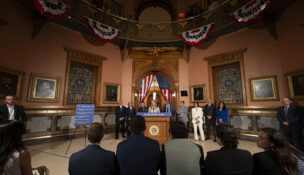
The first panel was a Legislative Leaders discussion with Assembly Speaker Craig Coughlin, D-19th District; Assembly Republican Leader John DiMaio, R-23rd District; Senate Budget Chair Paul Sarlo, D-36th District; and Senate Republican Leader Steve Oroho, R-24th District. The conversation was moderated by Siekerka and Eric Scott, New Jersey 101.5 morning news anchor and senior political director.
While the group mirrored a similar discussion from the recent League of Municipalities conference – with Sarlo filling in for Senate President Nick Scutari, D-22nd District – this event offered the opportunity to have the group face the business community to hear their concerns and offer solutions.
Scott kicked off the panel by noting that after the surprising outcomes of the last election, affordability became the buzz word of the day, mentioning those results of the NJBIA outlook. “So, I would ask our legislative panel, hearing those numbers, what is your reaction to this and what can Trenton do to improve the affordability climate for businesses?” Scott asked.
“The answer is we can continually and ought to continually look to do things that make New Jersey more affordable, not just for the business community, but for people at-large,” Coughlin responded. “And we’ve undertaken a number of those things.”
He noted the ANCHOR Property Tax program and the back-to-school tax holiday as well as legislation to address the Unemployment Insurance increase that businesses are facing. That last issue is a hot one and remains unresolved, becoming a big part of the discussion.
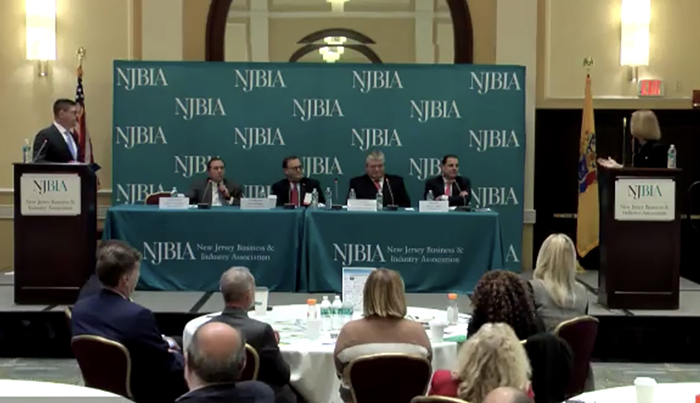
The speaker stressed that the work needs to continue with partners in the business community to figure out a comprehensive way to change New Jersey’s image regarding the business climate.
As Sarlo took his turn, Scott piggybacked off the UI issue Coughlin brought up, and asked Sarlo what happened to the bill in the Senate. The measure was spiked at the 11th hour during budget negotiations, reportedly at the behest of the administration.
“A little disappointed when it did get to the floor of the Senate and the feedback from the administration was that they wanted to put the brakes on it at that point in time, and would not sign it,” Sarlo explained.
He added that the work cannot stop on affordability and stressed that lawmakers need to revisit and work together with the business community on the UI issue, as well as allowing the corporate business tax surcharge to sunset when it comes up next year. “Those are two areas that we have some work to do that, hopefully, we can do in a bipartisan manner,” said Sarlo. “The third piece for me is something that I think we all get frustrated with — overregulation.”
After Scott pressed Sarlo further on the UI issue, the state senator reiterated that there is a plan to revisit the item, especially after the next round of revenue projections following holiday sales. When asked for a time frame, Sarlo estimated the first quarter of 2023.
The conversation then moved to government spending and the record Fiscal Year 2023 budget passed by Democrats in Trenton before shifting to the skyrocketing rate increase for state health benefits — another hot issue being felt around the entire state.
Scott asked if there is anything being done in the Legislature, or with the governor, to help mitigate the 22% or more increase for these benefit costs. “We’re going to have to come up with something to do,” DiMaio replied. “The reality is we need to understand how we got here so we don’t repeat that in the future. And then we need to find a way to mitigate it.”
Coughlin said there are conversations going on among the Legislature, the governor’s office and public employees.