Sign In
Upcoming Event
 Free Newsletter

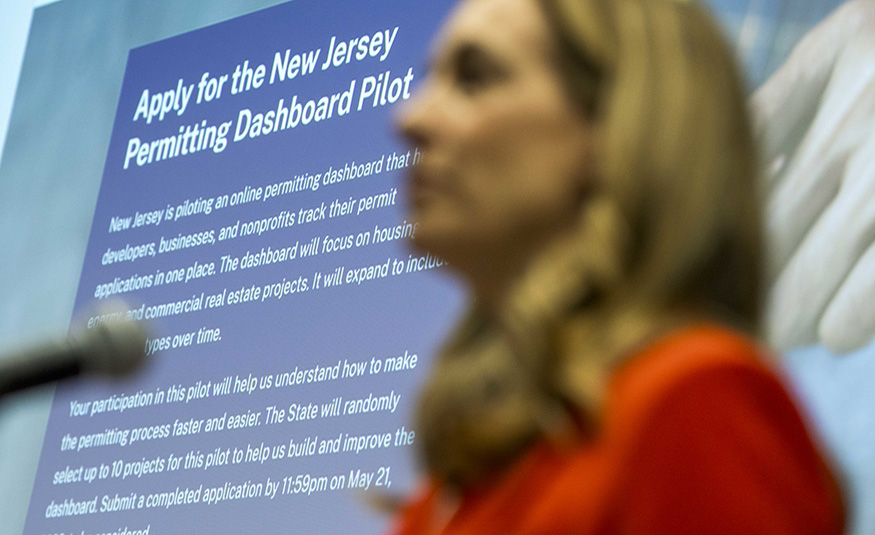
On April 30, 2026, in Trenton, Gov. Mikie Sherrill announced the opening of the online application for the Permitting Dashboard pilot program aimed at cutting red tape and streamlining bureaucracy. - PROVIDED BY NJ GOVERNOR'S OFFICE/TIM LARSEN
On April 30, 2026, in Trenton, Gov. Mikie Sherrill announced the opening of the online application for the Permitting Dashboard pilot program aimed at cutting red tape and streamlining bureaucracy. - PROVIDED BY NJ GOVERNOR'S OFFICE/TIM LARSEN
Sherrill names first projects for NJ permitting pilot
Matthew Fazelpoor//June 22, 2026//


 Listen to this article
The basics:
- NJ launches first public-facing permitting dashboard pilot
- 10 projects selected from 31 eligible applications
- Cohort includes housing, energy, infrastructure developments
- Dashboard designed to improve transparency, reduce permitting delays
Gov. Mikie Sherrill announced the launch of New Jersey’s Permitting Dashboard Pilot as well as the selection of the first 10 projects that will participate in the program.
The June 18 unveiling marks the next phase of an initiative announced in May as part of the governor’s 100th day in office. At that time, the administration opened applications for what it described as New Jersey’s first public-facing permitting dashboard. The tool aims to improve transparency and coordination across state agencies.
The pilot will test the new system. The dashboard provides project applicants and state agencies a shared view of status and permitting timelines. The transparency allows participating projects to track permits across multiple agencies in one location.
The first cohort was selected through an open application process that closed in May. It represents the housing, energy, commercial development and infrastructure sectors. The state randomly chose 10 projects from a pool of 31 applications that met eligibility requirements related to economic impact and permitting complexity.
The development of the dashboard comes as part of a broader effort to streamline permitting, reduce delays and provide applicants with a single platform to track approvals across multiple state agencies.
‘Stuck’ in the process
“New Jerseyans deserve a state government that is transparent, accountable, and efficient,” said Sherrill.
“For too long, residents, businesses, developers, and local governments have been stuck in a permitting process that’s slow, confusing, and difficult to navigate. The Permitting Dashboard Pilot is a big step in changing that,” she added. “The pilot projects will have a clear, real-time view of how they move through the permitting process and this will help us identify opportunities to reduce delays, improve coordination across agencies, and better support the projects our state needs.
First cohort:
Permitting Dashboard Pilot
The selected projects include six housing developments, three energy projects and one commercial infrastructure project.
Housing Projects
Active Acquisitions – McDowell Sand Mine Redevelopment, Wall Township
An 856-unit inclusionary residential development that includes 172 affordable units
D.R. Horton – Heritage Minerals, Manchester Township
A 2,450-unit residential development that includes 368 affordable units
Fairhaven Development – 11 US 9 Marmora, Upper Township
A mixed-use development featuring 98 residential units, including 20 affordable units, along with commercial space
HBC Liberty Village Urban Renewal – Liberty Village, Flemington
A 123-unit redevelopment project that includes 19 affordable units, retail renovation and flood mitigation improvements
K. Hovnanian Homes – Enclave at Middletown, Middletown
An 82-unit townhome redevelopment project that includes 17 affordable units on a former commercial property
White Rock NJ – White Rock at Jacksonville, Lincoln Park
A 104-unit multifamily development that includes 21 affordable units and emphasizes community-oriented, energy-efficient housing
Energy Projects
Jupiter Power – Woods Landing Energy Storage, Sayreville
A 200-megawatt utility-scale battery storage project located at a retired coal plant site
Osprey Energy – Egg Harbor City Landfill Redevelopment
A landfill redevelopment project that will host two community solar facilities totaling approximately 7 megawatts
Porches Solar – Woolwich Township
A 5-megawatt community solar project located on a former sand mine
Commercial Project
Echo Check Equities – HRC-Telco, Hoboken
A telecommunications infrastructure project intended to support regional network capacity and resilience.
“By making the permitting process more predictable, we can build the foundation for lower project costs, stronger investment, and a more affordable New Jersey.”
‘Changing how government works’
Chief Operating Officer Kellie Doucette said the pilot intends to help improve government operations and inform future development of a statewide dashboard.
“The Permitting Dashboard Pilot is about changing how government works,” said Doucette. “By creating a shared view of project status and permitting timelines, the dashboard will help pilot participants better understand where their projects stand while providing state agencies with new tools to monitor performance and improve coordination.
“The information and insights we gain through this pilot will help shape the development of a full statewide dashboard over time and inform future improvements to the permitting process.”
New Jersey Chief Innovation Officer Dave Cole said the initiative demonstrates how technology can be used to modernize government services.
“New Jersey’s innovation economy depends on our ability to move great ideas into the real world,” he said. “The Permitting Dashboard Pilot is an example of how we can use technology to improve government services, support investment, and reinforce New Jersey’s position as a leader in innovation.”
Moving ‘in the right direction’
Business groups applauded the announcement.

“For years, the business community has called for a permitting process that is more transparent, predictable, and efficient,” said Tom Bracken, president and CEO of the New Jersey Chamber of Commerce. “The Permitting Dashboard Pilot is an important step toward reducing uncertainty, improving accountability, and helping projects move from concept to completion more efficiently.
“A more competitive business climate depends on smart regulatory reform, and this initiative represents a meaningful step in that direction.”
Michele Siekerka, president and CEO of the New Jersey Business & Industry Association (NJBIA), said the initiative could help improve predictability for employers and investors across the state.

“From manufacturers and commercial developers to energy providers and small businesses, employers across New Jersey need a permitting process that works efficiently and predictably,” said Siekerka. “Greater transparency and accountability will help reduce uncertainty, support investment decisions, and make it easier to grow and create jobs in New Jersey.
“We applaud Gov. Sherrill’s efforts to modernize this process and strengthen the state’s economic competitiveness.”
You can check out the permitting dashboard here.