Sign In
Upcoming Event
 Free Newsletter

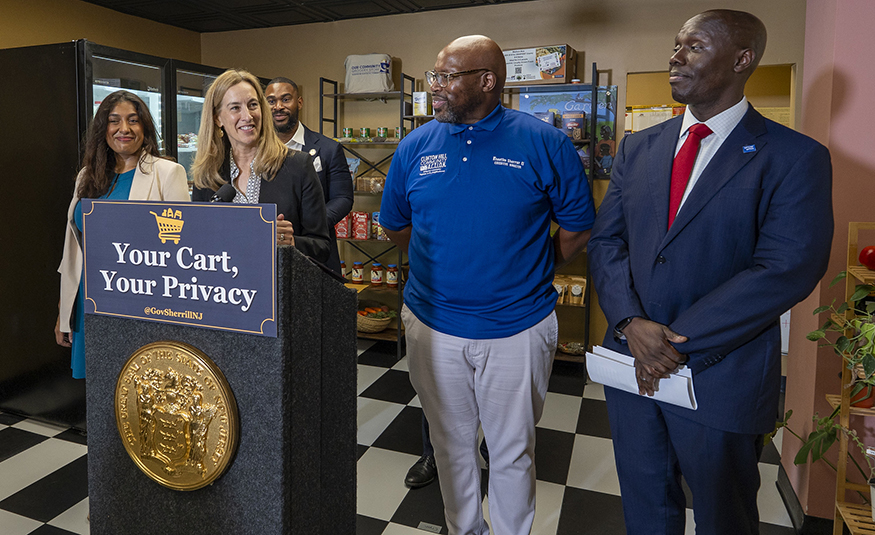
At Our Community Grocery Store in Newark on July 23, 2026, Gov. Mikie Sherrill held a news conference before signing a law banning retailers from using consumers' personal data to charge different prices for the same basic items. - PROVIDED BY NJ GOVERNOR'S OFFICE/TIM LARSEN
At Our Community Grocery Store in Newark on July 23, 2026, Gov. Mikie Sherrill held a news conference before signing a law banning retailers from using consumers' personal data to charge different prices for the same basic items. - PROVIDED BY NJ GOVERNOR'S OFFICE/TIM LARSEN
Sherrill signs NJ surveillance pricing ban (updated)
Kimberly Redmond//July 23, 2026//


)

The basics:
- Sherrill signs bill banning AI-driven surveillance pricing for groceries, food products
- Law prohibits pricing based on consumers’ personal or biometric data
- One-year moratorium imposed on new electronic shelf labels
- Violations can result in fines of up to $50,000 plus consumer fraud penalties
New Jersey is among a small but growing group of states targeting surveillance pricing.
As part of a law signed July 23 by Gov. Mikie Sherrill, the state made it illegal to use any pricing strategy that determines the cost of groceries and other food products based on consumers’ personal habits, including biometric, genetic and protected class information.
The Fair Price Protection Act also bars third-party delivery platforms from using consumer surveillance data to charge different prices to different shoppers for the same products, according to the bill.
However, it does not prevent food stores from providing consumers with discounts from a promotional price; benefits from a loyalty program; or offering different prices to broadly defined groups, such as teachers, veterans or senior citizens.
Breaking the law could lead to fines as high as $50,000. Offenders could also incur Consumer Fraud Act violations of up to $10,000 for a first offense and up to $20,000 for any subsequent offense, the legislation says.
Additionally, the bill establishes a one-year moratorium on the installation of new electronic shelving labels. Businesses that already use ESLs are allowed to continue their use. The state will conduct a study to determine the ESL’s impact on surveillance pricing and if they are compliant with the Consumer Fraud Act.
As written, the law goes into effect one year after enactment.
A growing trend
New Jersey now joins Maryland and Connecticut as the first states in the U.S. to prohibit personalized pricing for groceries. Other states, such as California, New York, Massachusetts and Illinois, are considering similar legislation.
Surveillance pricing came under scrutiny in December 2025 following an investigation by Consumer Reports.
The study found that third-party grocery delivery platform Instacart used an AI-driven algorithm to charge separate customers different prices for identical products from the same store based on analysis of their personal information.

Since then, U.S. Rep. Frank Pallone, D-6th District, has launched an inquiry into whether major retailers, grocery stores and pharmacies use AI algorithms to charge certain customers more based on their personal data.
There are currently no federal regulations regarding surveillance pricing practices.
Attention, shoppers
In New Jersey, state Sens. Joe Cryan, D-20th District, and Joe Lagana, D-38th District, sponsored the proposal. Assembly members Rosaura Bagolie, D-27th District; Annette Quijano, D-27th District; and Chigozie Onyema, D-28th District, backed companion legislation.
It passed June 30 with a 22-14 vote in the state Senate and a 51-20-1 vote in the state Assembly.
During a July 23 bill signing ceremony at Our Community Grocery Store in Newark, Sherill said, “New Jersey families are already feeling the pressure of higher costs. The last thing they need is companies secretly using their personal data to charge them more than someone else for the exact same product.”
If businesses want to compete, they should do so by offering better prices, not by finding new ways to squeeze shoppers.
—Gov. Mikie Sherrill
“If businesses want to compete, they should do so by offering better prices, not by finding new ways to squeeze shoppers. This law puts New Jersey shoppers first by protecting their privacy and ensuring fairness in pricing,” the Democratic governor said.

Sherrill has previously taken aim at surveillance pricing and pledged to move a ban forward as part of her affordability agenda. The Fair Price Protection Act complements Sherrill’s recent actions on junk fees and algorithmic rent-setting, her office noted.

New Jersey Attorney General Jennifer Davenport thanked Sherrill and the state Legislature “for taking this important step towards making groceries more affordable, protecting the data privacy of New Jersey consumers, and ensuring a fair marketplace for household essentials.”
She added, “The price New Jersey Families pay at the grocery store should be based on the cost of a product, not on what invasive data collection suggests they may be willing to pay. My office is committed to enforcing this new law to ensure grocery prices are fair, transparent, consistent, and not driven by the exploitation of consumers’ personal data.”
‘An abuse of modern technology’
Cryan described surveillance pricing as “an abuse of modern technology where artificial intelligence is used to set different prices for different customers.”
“Consumers are being hurt at a time when families are already struggling to pay their bills. They should be protected from the intrusive use of algorithms, personal data and other technologies to exploit their food purchases or individual characteristics,” he went on.
Lagana added, “Surveillance pricing isn’t innovation at its finest, but a modern form of consumer fraud that quietly manipulates prices based on a customer’s private online behavior. At a time when families are already struggling with the rising cost of basic necessities, the Fair Price Protection Act will put a stop to these deceptive practices and ensure businesses treat shoppers equally, without weaponizing their own personal data against them.”
Onyema shared, “Consumers should not have to wonder whether the price they see is the same price someone else is paying for the exact same product. As technology becomes more sophisticated, so do the ways companies can use personal information to influence what people pay … Fairness, transparency, and privacy should not disappear simply because a transaction happens online or through an app.”
You searched for a breakfast recipe. Now the eggs in your online cart cost more.
That’s surveillance pricing – companies using your personal data to charge you more for the same groceries.
I signed legislation to put a stop it to it in New Jersey – giving shoppers the… pic.twitter.com/0kACjFxX19
— Governor Mikie Sherrill (@GovSherrillNJ) July 23, 2026
Supporters say
Several community advocacy groups also applauded Sherrill for signing the legislation.
New Jersey Citizen Action Executive Director Dena Mottola Jaborska shared, “Surveillance-based pricing is a threat to marketplace fairness, consumer privacy, and affordability. At a time when families across New Jersey are struggling to make ends meet, the idea that the price of something as essential as groceries could be manipulated, often based on information that isn’t even reliable, just to maximize profits, is unacceptable. The Fair Price Protection Act restores a basic principle of consumer fairness,” Mottola said.
Six locals within the United Food and Commercial Workers and two locals in the Retail, Wholesale and Department Store Union celebrated the bill’s signing, too.
“Gov. Sherrill and the Garden State have kick-started the fight against AI-powered price gouging in grocery stores. By imposing a moratorium on electronic shelf labels, New Jersey is protecting grocery workers and consumers from harmful technology aimed at squeezing every last dime out of hardworking families,” they said. “UFCW and RWDSU members know how disruptive ESLs are, which is why we thank Senate President [Nicholas] Scutari, Speaker [Craig] Coughlin, Senator Cryan, and Assemblyman Onyema, who championed this bill.”
Unintended consequences?
Not everyone is cheering the bill signing, however.
The measure has been opposed by Republican lawmakers in the state. A coalition of New Jersey business groups has also come out against the proposal, including:
- Commerce and Industry Association of New Jersey
- New Jersey Business & Industry Association
- New Jersey Food Council
- New Jersey Retail Merchants Association
- New Jersey Chamber of Commerce
The retail groups have argued that the measure is overly broad and could unintentionally eliminate personalized discounts, loyalty rewards and targeted promotions that help many shoppers save money.
They say there is a difference between transparent, consumer-driven discounts and hidden surveillance pricing, warning that stricter rules could lead retailers to adopt uniform pricing and potentially raise prices for everyone.
‘A false choice’

Following the signing of the Fair Price Protection Act into law, NJBIA President and CEO Michele Siekerka issued a statement saying, “While we can appreciate the intention of strengthening consumer trust and transparency in the pricing of groceries and food goods, this legislation ultimately went to the governor’s desk with a false choice between those consumer protections and operational efficiencies for our store owners –- when it could have achieved both.”
“In the end, this law will compromise the very cost-saving programs that consumers rely on, particularly during an affordability crisis. The unintended consequences could very well be the elimination of some loyalty programs, coupons, and other customer-specific discounts due to new limits on consumer data,” she said.
“Simultaneously, rather than recognizing the strong consumer protections and unit pricing rules already in place in New Jersey, our policymakers once again sought to go one step further and to make New Jersey businesses the bad guy when most are simply trying to communicate prices in a timelier and more efficient manner,” Siekerka continued.
“Further, this is yet another change in the rules of how to do business in New Jersey, bringing even more uncertainty when our job creators need predictability to conduct business and make investments in the future,” she said.
Chamber of Progress Policy Manager Drew Ambrogi added, “Governor Sherrill had an opportunity to protect New Jersey consumers from unfair price increases, but instead signed a bill that will also take away the discounts families use every day. Unless the Legislature fixes this bill later this year, New Jersey families could wake up in 2027 to find that everyday discounts available across state lines are no longer available at home. Consumer protection laws shouldn’t make it harder to save at the register.”
Editor’s note: This story was updated at 3:43 p.m. July 23, 2026, to include information that was inadvertently omitted from the second paragraph. The story was then updated at 11:24 a.m. July 24 to include a statement from Chamber of Progress Policy Manager Drew Ambrogi.