Sign In
Upcoming Event
 Free Newsletter


$2B DuPont PFAS settlement is largest in NJ, US history
Jessica Perry//August 4, 2025//


The basics:
- NJ reached a $2B+ PFAS settlement with DuPont, Chemours and others
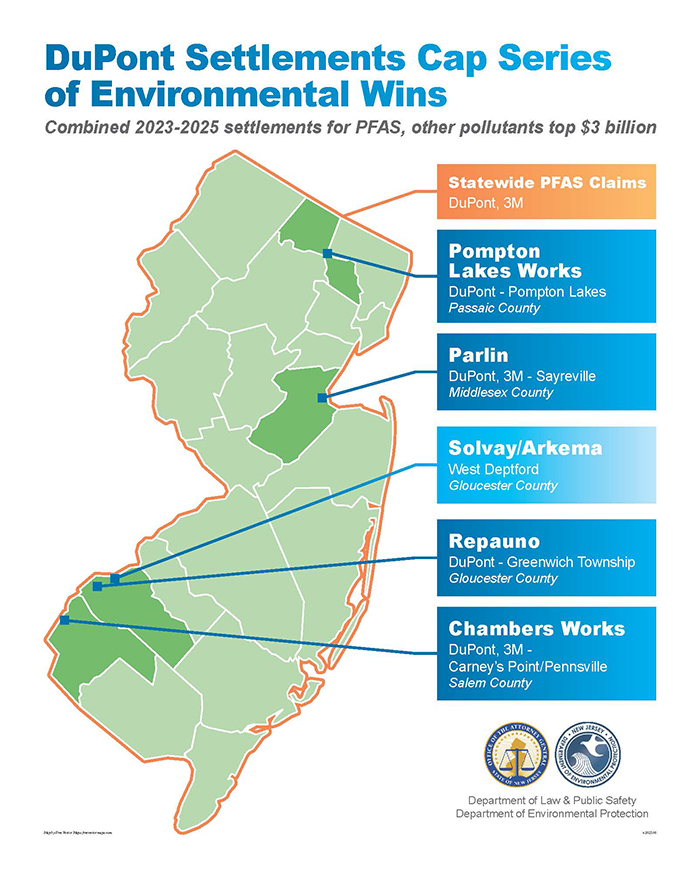
- Covers contaminated sites in Pompton Lakes, Sayreville, Greenwich, Carney’s Point
- Includes $875M in damages, abatement funds and water treatment
- Settlement establishes $1.2B remediation fund and $475M reserve fund
New Jersey revealed a landmark environmental settlement Monday to resolve PFAS contamination, and other pollutants, at four sites statewide.
Valued at more than $2 billion, the joint announcement from Attorney General Matthew Platkin and Department of Environmental Protection Commissioner Shawn LaTourette will address the “forever chemicals” in Pompton Lakes, Sayreville, Greenwich Township and Carney’s Point. Corporate defendants include Delaware-basedE.I. Dupont de Nemours and Co. (now EIDP Inc.) and other DuPont-related entities.
While LaTourette noted the deal would mark the largest ever in New Jersey, Platkin adds the value would also stand as the largest environmental settlement ever achieved by a single U.S. state.
In addition to addressing per- and polyfluoroalkyl substances (PFAS) in the Chambers Works case, the agreement also resolves three other lawsuits regarding statewide claims for the firefighting material known as aqueous film-forming foam (AFFF) and DuPont and its related entities’ responsibilities under a 2019 New Jersey PFAS directive, the state said.
The settlement marks the third major PFAS win for the administration in more than two years. Since 2019, the state says it will recover approximately $3 billion from lawsuits seeking to compensate and remediate for damage from forever chemicals and other pollutants.
Breaking it down
Besides EIDP, the other corporate defendants in the latest are: The Chemours Co. and The Chemours Co. FC LLC, both of which DuPont spun off in 2015; DuPont Specialty Products USA LLC; Corteva Inc.; and DuPont de Nemours Inc. According to the New Jersey Department of Environmental Protection and the Office of the Attorney General, the companies agreed to:
- Fully clean up contamination at the four New Jersey sites
- Pay $875 million in natural resource and other damages plus abatement funds to the state for harm to land, water and other natural resources
- $225 million will go toward natural resource restoration in water regions associated with each of these industrial sites
- $125 million will go toward costs, fees, penalties and punitive damages
- Fund abatement projects including drinking water treatment
The sites comprise:
- Pompton Lakes Works, Pompton Lakes and Wanaque, Passaic County
- The Parlin site, Sayreville, Middlesex County
- The Repauno site, Greenwich Township, Gloucester County
- Chambers Works, Pennsville and Carney’s Point, Salem County
According to NJDEP and the OAG, payments from entities entering the settlement would occur annually for 25 years. According to the department, it will hold the $875 million in funds in a dedicated trust account to address PFAS and other contamination, including through the provision of drinking water treatment.
Who gets what?
According to NJDEP Commissioner Shawn LaTourette, the $875 million includes:
- $75 million toward the Pompton Lake site and its water region
- $30 million toward the Parlin work site in its water region
- $20 million toward the Repauno site and natural resource restoration in its water region
- $100 million toward the Chambers work site and its water region
In keeping public funds out of the cleanup efforts, the state also said the companies agreed to create a remediation funding source of up to $1.2 billion as well as establish an additional reserve abatement fund of $475 million to ensure that if any one of the companies goes bankrupt, or otherwise fails to fulfill its responsibilities to the state, taxpayers won’t foot the bill.
The state described the extra financial protection as a critical component of the settlement, adding NJDEP’s lawsuit alleged DuPont attempted to avoid this liability in spinning off Chemours.
“First and foremost the most important piece of this settlement is to ensure that those four industrial sites are fully cleaned up to the satisfaction of the Department of Environmental Protection without any limitation or restriction on our ability to ensure the completeness of that cleanup. And that the companies put forth the remedial funding source that will support that long-term cleanup of contamination at and emanating from these four sites,” Commissioner Shawn LaTourette said during an Aug. 4 press briefing, noting the $1.2 billion will go toward that effort.
Trial work
Law firm Kelley Drye & Warren LLP assisted the state in the latest, as well as the prior $450 million PFAS settlement with 3M.
Kelley Drye noted the trial began in Camden May 19 before Chief Judge Renée Marie Bumb, U.S. District Judge for the District of New Jersey. After several combined bench trials over four weeks, the state reached the settlement before a jury trial could begin.
DYK
Teflon, one of the “founding fathers” of the PFAS family of chemicals, as the Hazard NJ podcast from NJ Spotlight News details it, was born at Dupont’s Chambers Works site in South Jersey — the same location at the center of this case?
Kelley Drye Environmental practice co-chair William Jackson served as lead counsel for the State of New Jersey. “The New Jersey Department of Environmental Protection and the New Jersey Attorney General’s Office continue to lead by example,” Jackson said in a Monday announcement from the firm.
In 2024 and 2025, Kelley Drye secured settlements with Solvay Specialty Polymers USA LLC and Arkema over PFAS discharges from operations in West Deptford. Together with the DuPont and 3M cases, the firm said, the team has helped New Jersey recover more than $3 billion in PFAS-related remediation, restoration and natural resource damages.
Looking back
New Jersey’s industrial and manufacturing history, and the work to address its impacts, have positioned the state as a national leader in assessing and responding to PFAS risks.
According to the state, New Jersey was the first in the nation to set maximum contaminant levels (i.e., enforceable drinking water standards) for certain PFAS. It added the Garden State also led the way in conducting statewide occurrence studies of PFAS in drinking water.
Manufacturing and industrial activity at the included sites dates to the late 1800s, according to the state. In the present, they continue at the Chambers Works and Parlin properties. (See our slideshow above for more background.)
LaTourette noted that timelines would differ from site to site, as they each require specific remedial actions and are at different points in that journey. He added those activities will also extend “well into the future,” with some required to maintain remedial measures into perpetuity.
“The most important point, however, is that the remedial funding source and the backstop will provide the security that these remedial measures are funded for as long as it takes to clean them up to whatever standard set by the state government,” he noted. “And this is a big deal because previously these companies were not seeking to be held to this highest standard … Otherwise we would not have had to sue them in the first place.”
What’s next
While funds are not intended to reimburse businesses for costs of cleanup they may have had to undertake, LaTourette noted in response to a query from NJBIZ that relief for small businesses in the vicinities of these sites that source water from a well that is contaminated with PFAS may have an avenue. “There may be relief for that type of a business that it affected in the same way that an individual or community is affected,” he said.
The settlement will publish in the New Jersey Register in September, kickstarting a 60-day public comment period on the proposal. After, LaTourette said the intent is to respond and meet before the court for final resolution by the end of this year, if possible.

“We’ve got a long way to go in fully remediating these sites, but it will be done,” LaTourette said, expressing thanks to the OAG, Division of Law, outside special counsel and the NJDEP. “We have a long way to go in fully responding to the risks that PFAS forever chemicals pose to the people of New Jersey, their health and their environment.
“But with the resources provided from this settlement and others, we are putting ourselves on incredibly good footing to tackle this problem.”