Sign In
Upcoming Event
 Free Newsletter

DEPOSIT PHOTOS
DEPOSIT PHOTOS
Employers tap AI for benefits, but workers remain cautious
Jessica Perry//June 22, 2026//


The basics:
- Prudential: 83% of employers interested in using AI for benefits guidance
- Only 58% of employees say they would use AI for benefits
- Privacy, security and trust are top AI concerns
- 70% of employers trust AI to personalize benefits advice
While employers are ready to accept an AI assist when it comes to enhancing workplace benefits, their employees remain cautious.
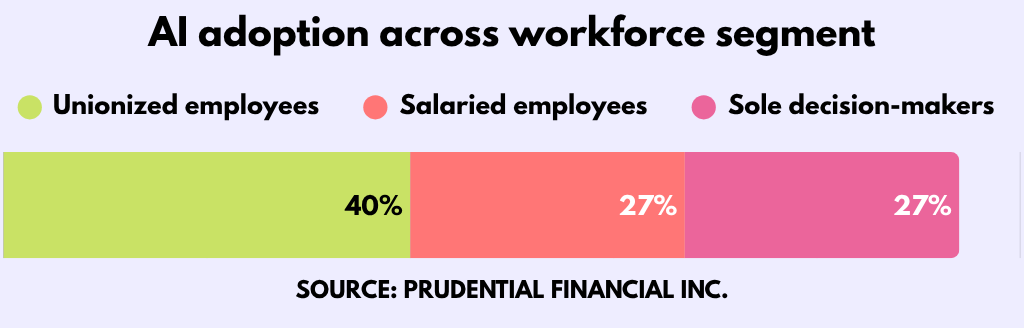
Prudential Financial Inc.‘s second installment of the 2026 Benefits & Beyond study dropped June 22. The latest report finds that more than 8 in 10 employers (83%) express interest in using artificial intelligence to help their workers get a better grasp on their health benefits. However, only 58% of this target audience say they would use the service. And even less – 24% – do so already.
For Prudential, like Billy Joel, it’s all a matter of trust.
Introducing the findings, Prudential Vice President, Group Insurance and Chief Technology Officer Scott Roth acknowledged employers’ recognition of the benefits AI can bring to the workplace. However, he highlighted the importance of establishing cultural infrastructure around the technology to ensure success.
“Our research indicates that employees are willing to engage with AI to learn about their benefits, provided they can trust their employers to manage their data responsibly,” Roth writes. “This is our foundation.”
Our research indicates that employees are willing to engage with AI to learn about their benefits, provided they can trust their employers to manage their data responsibly.
—Scott Roth, Prudential
To close the gap, he advises three focus areas: transparency around data security, educating employees to feel empowered and keeping humans at the center of the tech.
Prudential conducted the survey of 3,096 full-time U.S. employees and 760 employers via national online polls in January 2026.
AI workplace adoption and concerns
According to Prudential, 87% of organizations and 79% of employees say they’re already using AI in some capacity, whether at work, home or elsewhere.
But while higher-ups are high on AI, the same sentiment does not appear to filter through the ranks.
Drinking the Kool Aid
Prudential said employees who feel the most pressure to use AI, also feel most positive about the tech. The report framed the “pressure” as more about enthusiastic encouragement than a negative push:
65% — Very/extremely pressured
55% — Somewhat pressured
49% — Not at all/not too pressured
While most (59%) admitted to using AI to help answer personal life questions, 53% said they use AI to work more efficiently. Additionally, 51% say they use it to answer questions they have in their roles at work. Millennials lead in professional usage of AI, according to the results. Boomers fall at the other end of the spectrum. That latter group is also most likely to engage the tech for personal advice, according to the findings.
Employers and employees aligned on the top five concerns surrounding AI:
- Privacy and security concerns
- Concern with inaccuracy and reliability
- Moral/ethical concerns
- Impact on children
- Impact on education
However, the biggest gap emerged in one of the most important areas: trust.
Prudential reported a quarter of employees do not trust AI, while only 12% of employers have the same concern.
Opportunities in HR
HR decision makers are using AI in a variety of ways. The report identifies the top uses as:
- Helping research topics 86%
- Résumé screening 77%
- Predicting with data (e.g., data analytics, business intelligence) 80%
- Helping write and organize emails 73%
- Creating educational materials for benefits and/or enrollment 72%
Most employers (70%) said they trust AI to provide benefit advice and personalization to employees. Prudential notes this can help fulfill a desire for that kind of experience to make better benefits decisions, including during open enrollment.
According to the report, AI offers a roadway to making this happen, “But only if employees trust them.”
“That means helping people understand how these tools work, how their data is protected, and how AI can strengthen the human support they still want and need when making important benefits decisions,” said Michael Estep, president of Prudential Group Insurance.
Specifically in the benefits space, Prudential reported employers’ top five fears included one tie:
- Concerns about sharing employees’ personally identifiable information and other sensitive information 40%
- Communicating the role of AI to employees to encourage understanding and introduction 33%
- Challenges in training/reskilling HR staff 37%
- Concerns about mistakes impacting employees’ well-being 31%
- Employee pushback in implementing AI 27%
- Skepticism that AI will solve what it claims to solve in the benefit space 27%
Other uses with more than 50% support (and reaching as high as 67%) include cybersecurity, quality control, help making benefits decisions, upskilling talent, responding to employee questions and redesigning processes.
Balancing act
Prudential reports about a quarter of employees say they use AI to learn about their workplace benefits, which provides ample space to grow. However, having the tools on hand does no good if people don’t know how – or are unwilling to – use them.
65%
of employees overall are comfortable with their employer managing their PII — e.g. Social Security numbers, health records & financial data
Employees with young children (65%) and teens (62%) are more likely to want personalized benefits information
The report recommends combining hands-on experience with comprehensive education to help convert employee concern around AI into confidence. And benefits can offer an on-ramp toward that end.
To combat disconnects between employer confidence and worker uncertainty, tools should also be introduced along with comprehensive education so employees understand how they work, why the business is using them, and how the tech can help their own role or experience.
The report recommends proactive, transparent communication that offers specific answers.
At the end of the day, keeping the human element at the core of what you do can help to ensure success for both employers and employees.
“Employee benefits is one of the clearest applications for AI given how complex and individual these decisions can be,” said Roth. “Many employees still struggle to navigate their benefits options. AI can help simplify that, but they need confidence in the guidance they receive and how their information is handled.