Sign In
Upcoming Event
 Free Newsletter


For Egg Harbor-based Spirit Halloween, summer is the ramp-up to spooky season. - DEPOSIT PHOTOS
For Egg Harbor-based Spirit Halloween, summer is the ramp-up to spooky season. - DEPOSIT PHOTOS
How Spirit Halloween gets up and running for its big season
Kimberly Redmond//June 17, 2024//


For many retailers, summer is about everything from swimsuits to yard tools to hamburger buns. For pop-up chain Spirit Halloween, it’s the ramp-up to spooky season.
Starting in August, the Egg Harbor-based specialty retailer will rise up from beyond and possess empty storefronts in shopping plazas and strip malls across North America, selling decorations, costumes, props and accessories for the spookiest night of the year. Then, after Oct. 31, Spirit Halloween vanishes without a trace and can only be found on its e-commerce site.
With less than four months to go before Halloween, the Spencer Spirit Holdings Inc.-owned brand recently kicked off efforts to hire 50,000 seasonal employees to support the more than 1,500 stores expected to open nationwide this year.
While Spirit Halloween isn’t the only temporary store to set up for Halloween, its network of seasonal shops is certainly the biggest serving the $12 billion-plus Halloween consumer market.
Commenting on the upcoming openings, Spirit Halloween’s chief executive officer Steven Silverstein said, “The excitement and enthusiasm of Halloween continues to grow, and as we gear up for another season, we are looking forward to welcoming new associates and store managers to our team.
“Opening over 1,500 retail locations is no small feat, and much of the magic we create for fans each year is thanks to the passion and dedication of our associates who bring the Spirit Halloween experience to life,” he said.
Skeleton crew
Though Spirit Halloween is only physically present from late summer until early November, the company’s corporate team is working behind the scenes year-round.
In addition to analyzing available real estate and market trends and securing leases, the company’s process also includes determining which products it will carry and hiring seasonal employees.
According to CNBC, inventory carryover from season to season is “very minimal” and items that are unsold and in good condition are stored for next season. Additionally, merchandise is available to purchase all year through Spirit Halloween’s website.
As for the tens of thousands of employees brought in for the season, the company reportedly offers many of them the ability to stay onboard with the company in a role at Spencer’s Gifts, which is owned by Spirit Halloween’s parent company.

“It’s a year-round process even though we only see three months a year. Their fixtures are shipped out and stored after a season ends. District managers take possession and start the build out of the spaces pretty early where they can. It’s all very self-contained and efficient,” said Sidney Singer, vice president of leasing for Levin Management Corp.
For 2024, the North Plainfield-based commercial real estate firm anticipates five Spirit Halloween sites in its portfolio: three in New Jersey, one in Pennsylvania and one in Virginia, according to Singer.
During a 2012 interview for Kimco Realty’s podcast, Spirit Halloween’s senior director of real estate Frank Pacera discussed the process, saying, “Pretty much Nov. 1, the minute our door is closed, we are – or actually, before our doors close – we are prepping for the next season. We literally are, 12 months out of the year, getting ready for this holiday. … Right after we close our doors, we have a field operation of people who are based throughout the country, and they basically scout their entire markets that they’re responsible for on a regular basis.”
Spirit Halloween is generally tight-lipped about the magic it uses to conjure up hundreds and hundreds of locations every year. A spokesperson for the company told NJBIZ it doesn’t disclose specifics around sourcing space and what the process entails.
“Having said that, I can share our team works year-round to identify stores in lifestyle centers, strip centers, free-standing stores, major downtown retail locations and in major malls that are surrounded by a national retailer mix. Ideal locations for a Spirit Halloween store offer between 5,000 and 50,000 square feet of sales floor space with great visibility,” the media representative said.
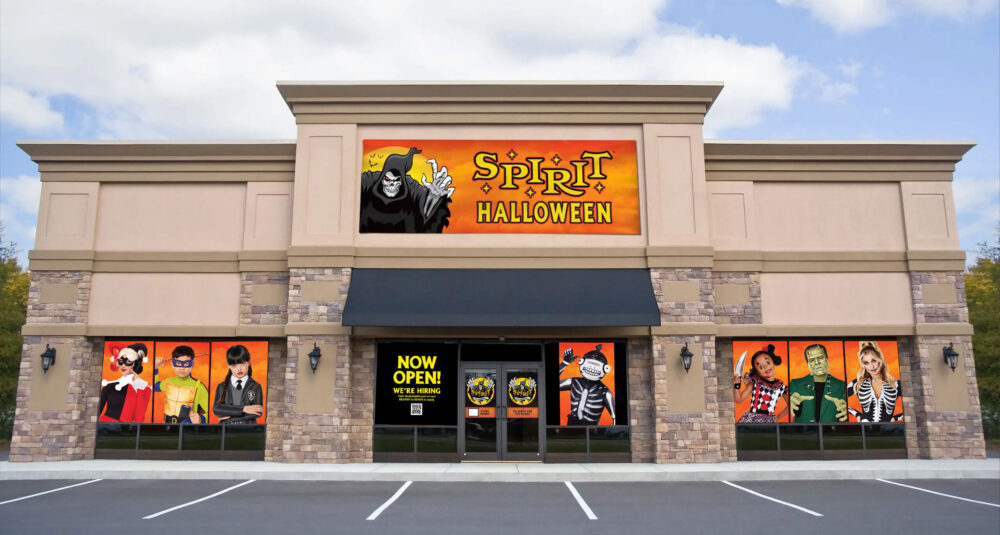
According to Spirit Halloween’s website, the brand seeks to open on or about Sept. 1 and remain open through Nov. 1, so its optimal lease runs from mid-July through mid-November.
Other criteria Spirit Halloween says it looks for in a location are:
- A three-month lease that includes a kick-out clause should the landlord secure a permanent deal by June;
- Within a 3- to 5-mile radius of a population of 35,000-plus people;
- A daily car count of at least 25,000.
“Our flexibility is key! While our locations feature between 5,000 to 50,000 square feet of sales floor space with awesome visibility, no store is too large (or too small),” the company noted.
In recent years, when struggling retailers like Rite Aid, Bed Bath & Beyond and CVS Pharmacy closed locations, it presented an opportunity for Spirit Halloween. It was also a positive for commercial landlords because it meant unused space was leased — if even for just a few months.

Now, with the vacancy rate at U.S. shopping centers nationwide at a 15-year-low, it may be tougher for temporary retailers.
In a report earlier this year on first quarter retail real estate results, Cushman & Wakefield found that the lack of new retail construction and limited supply of available space in high-quality retail centers “has placed a ceiling on the amount of new leasing activity.” Average asking rents in the sector are also 4.1% higher than a year ago, up 17% from 2019 and over 41% over the past decade.
Cushman’s analysis said, “Nonetheless, the retail market remains in a decidedly stronger place than prior to the pandemic, as consumers and retailers have shown a renewed appreciation for the in-person shopping experience.”

Scott Auster, executive vice president and head of leasing for Urban Edge Properties, said, “It’s a lot harder to find this year certainly than it’s been in years past because of all the leasing activity that’s taken place at our portfolio over the last 24 to 36 months.”
“I think we probably had close to double the number of Spirit Halloweens last year as we’re going to have this year and that’s entirely a function of availability,” said Auster, noting Urban Edge expects to have about four stores for 2024.
“We’ve been fortunate to lease a lot of our vacancies throughout the portfolio to really good credit tenants that are doing permanent leases in our shopping centers and there’s just less opportunity for the pop-up tenants that do these short-term deals on seasonal basis,” he said.
“I would suspect that their experience with a lot of other landlords this year is similar to what it’s been with Urban Edge, which is that there’s just less opportunities and a lot of those centers for them to do stores that they might’ve done multiple years in the past because those vacancies were chronic and going on there for a while,” Auster explained.
Getting into the spirit
The logistics behind launching that many pop-ups may seem scary, but Auster said Spirit Halloween is “a very well-run company.”
“It takes a lot of planning and strategy to execute a 1,500-store program every single year and starting from zero every single time,” he said. “And they’re doing it all year round. They’re not waiting until the Halloween season to secure these spaces.”
At Urban Edge, a New York City-headquartered real estate investment trust, Auster said, “We negotiate our deals with Spirit and other seasonal operators that want to open during Halloween season in the spring.”
It takes a lot of planning and strategy to execute a 1,500-store program every single year and starting from zero every single time.
– Scott Auster, Urban Edge Properties
“The challenge to that is sometimes we have active negotiations with tenants on spaces, but they’re not quite done yet, and we’re trying to figure out whether we could still do a Spirit Halloween deal in October or is it possible that that lease is going to be signed by October and we’re going to need access to the space for that permanent tenant,” Auster said.
“So, you’re always looking out ahead a few months and trying to gauge if you have activity on that space, whether that space is still going to be available because Spirit secures those spaces in the spring and expects that they’re going to be there when they actually do their sales in September and October. There is a little bit of a guessing game that occurs there to make sure that you can have those spaces available.”
Auster said, “Once you secure them with Spirit – usually by June – they need to know that you’re in or out. So, you need to make that commitment to them then that you’re going to have that space available and that you’re not going to have anybody else for that space during that time.”
Both Singer and Auster declined to say how much a lease for Sprit Halloween could run and pointed to several factors, including geographic region, square footage and population demographics.
Auster said, “It has to be enough where it’s worth the landlord to keep that space off the market for the period of time that we’re talking about but can’t be too much that Spirit’s not able to turn a profit. There’s always that back and forth that occurs. We’re not going to just take this thing off the market for a few months for something that we don’t think is worth it for us economically. So, it’s mutually beneficial, I would say.”
Temporary tenants often reportedly pay more in rent than long-term tenants and Spirit Halloween typically offers above-market rates, Bloomberg reported in 2014. According to the Las Vegas Review Journal, a Nevada commercial real estate brokerage once saw a two-month lease for a Halloween store fetch $30,000 in rent.
Auster said, “Historically, spaces that they’ve taken have been very big because they like to put a lot of inventory in there and see what actually sells. But this year, I would suspect with a lot of the bigger spaces that they’ve historically been able to go into that have been vacant now being leased, that they might be looking at a more flexible model this year and take spaces that are a little bit smaller just because they’re looking for whatever availability they could find to fill their store count.”
Spirit Halloween has inhabited everything from vacant Toys R Us stores to shuttered supermarkets to the onetime Barneys flagship in New York City, so the company has become adept at making a property meet its needs.

Singer said, “In truth, it’s a good problem to have as a landlord to say there is limited availability. And Spirit Halloween has been flexible. If there is a very large space, they will take it and make it feel like a store in their typical footprint by putting up partition walls. If there is a smaller availability in a market where they need to be, they will forego the animatronics and set up as traditional retail store with less experience.”
“Every landlord prefers a permanent long-term tenant in a vacancy over having something seasonal. But it’s a high expectation to have a fully leased property with no transition over the course of time. A seasonal store adds a nice little income to help offset some of the costs a landlord pays when carrying a vacancy. It also brings in some excitement. This is high-end traffic – a mini holiday rush outside the traditional holiday shopping season,” he explained.
Always a treat
“They’ve always been a good partner with us and we’ve enjoyed a good relationship with them for many years,” said Auster.
When asked how landlords perceive short-term leases, like Spirit Halloween, Auster said, “If given the choice between a long-term permanent tenant and a seasonal location, obviously we would prefer a long-term tenancy in all our spaces in our shopping centers.
“Certainly, there’s the economic benefit of even securing a few months of revenue on a vacancy that you have in a shopping center where you don’t have any deals that are imminent for a permanent tenant,” Auster said. “It’s great to put somebody in there and get some revenue, but on top of that, the seasonal stores, especially the good operators – and I would put Spirit Halloween in that category for sure – are good for traffic.
“They bring in a lot of people during that peak season and those are potential customers that can shop the rest of the shopping center when they’re there. So, it’s always better to have a space occupied than vacant, and even if it’s on a temporary basis, if it’s the right user, we enjoy the traffic that those users generate, even if it’s for a short period of time. So, beyond the economic benefit, there’s certainly a merchandise tax benefit and a traffic driver that these stores are able to generate for us that we like. And it’s a differentiated product, too,” Auster said.
Singer said ventures like Spirit Halloween are “a positive for a landlord that has available space or space in transition between tenants.
“It provides a nice pop of traffic that benefits the center and its tenants. Spirit Halloween is an interactive, family-friendly experience — kids love the animation and displays. Halloween is really one of the most popular holidays. People get into it with their parties and whatnot. This all benefits a shopping center that has a vacancy,” he continued.

Both Levin and Urban Edge said they always have a good experience working with Spirit Halloween.
Auster said, “I have nothing but good things to say about them. As an operator, we have a great specialty leasing team at Urban Edge that’s part of our leasing department that I manage and they deal with all of these pop-ups, seasonal and short-term leases … They’ve enjoyed a really good relationship with Spirit Halloween and have been doing business with them for many, many years. And, we continue to enjoy having them in the centers when it makes sense.”
Auster went on to say, “There’s not that many tenants that we do multiple transactions with on an annual basis as a temporary operation, but Spirit is one of those that we do multiple deals with on an annual basis. It’s definitely an important strategic relationship for the specialty leasing group.”
A horrific background
Spirit Halloween isn’t the only brand of seasonal shops for Halloween though it may be the most well-known. Other players in the space include Woodcliff Lake-headquartered Party City and Halloween Express.
Spirit was founded 41 years ago by Joe Marver in a San Francisco mall and later acquired in 1999 by Spencer Gifts – the mall brand known for gag gifts.
For Spencer’s – which got its brick-and-mortar start in 1963 at the Cherry Hill Mall – Spirit Halloween represents a significant part of its bottom line, reportedly contributing about 15% of overall revenue.
Singer said, “Spirit Halloween put their mark on it – that’s an opinion not based on fact. I’ve been in retail for most of my career. Most seasonal/pop-ups are not as consistent – they tend to be transitional based on the need of a market. I haven’t seen many be so successful year over year over year.”
Since 2009, Spirit Halloween has more than doubled its number of locations as Halloween spending in the U.S. continues to rise. The average consumer shelled out $108.24 last year to celebrate the holiday, according to the National Retail Federation.
The greatest increase in spending comes from costumes, which NRF says are more popular than ever. According to NRF, the average spend on a costume is $36.84.
Spirit Halloween’s approach of inhabiting shuttered stores has become synonymous in recent years with the retail apocalypse, inspiring countless internet memes. The brand also found itself as the toast of social media when Halloween revelers, celebrities and brands began sharing self-made memes of the company’s widely recognized costume bag with their own spin on the characters inside. Spirit also helped produce “Spirit Halloween: The Movie,” a film released two years ago starring Christopher Lloyd and Rachel Leigh Cook that follows middle schoolers locked in a haunted Spirit Halloween store on Halloween night.
In April – six months ahead of the holiday – Spirit Halloween launched a “Halfway to Halloween” campaign to drum up excitement and offered fans a chance to win a private stay in one of the nation’s most famous haunted houses: the Lizzie Borden House in Fall River, Mass.
The retailer also announced the Aug. 1 opening of its flagship store in Egg Harbor, an annual event that includes exclusive early reveals, games, treats, themed photo opportunities and family-friendly activities.
Silverstein described Halfway to Halloween as a celebration designed to “provide fans an exhilarating taste of what’s to come this fall and empower them to start planning for their favorite season as early as they please.”
What’s popping
Auster believes there’s a few reasons behind the continuing popularity of the pop-up and seasonal stores.
For retail properties, it is a way to keep shopping areas fresh and vibrant by constantly offering something new for customers to explore. For brands, it’s a form of experiential marketing that allows them to test new ideas and locations.
“If you go back to the time where they became really popular a few years ago, there was a lot of availability in shopping centers and landlords were more willing to do seasonal pop-up stores as opposed to permanent stores,” Auster said. “And then I think there was a lot of what you’ll call incubator level retail concepts – people that maybe were digital brands as they started, but want to get into the shopping center game, but don’t want to make a big commitment.
“They wanted to test something out as a brick-and-mortar store before they decided if it’s something they really wanted to roll out. I think there were temporary and pop-up stores that occurred because of that,” Auster said.
“There’s also well-established retail concepts that have fleet stores, but just want to try something new or something different, whether it’s a concept they’re testing out or whether it’s a new market they’re going into that they don’t have experience in before and they’ve done some sort of temporary store,” he went on.
“As landlords, obviously we’d always prefer to have a permanent tenant in our centers as opposed to a temporary one. But, if it’s an interesting brand, interesting product or concept, we think it’s a nice little supplement to what we have existing in a lot of cases, and it’s a differentiated product that we could bring into our shopping centers and drawing new customers or bring back existing customers to try something different,” Auster said.

For instance, Englewood Cliffs-based Unilever USA’s Dove beauty brand created an in-person experience in February by opening a limited-time cocktail bar in New York City to promote a new collection of soaps.
Bloomingdale’s also debuted a summer camp-themed pop-up shop in New Jersey recently at the Shops at Riverside in Hackensack and The Mall at Short Hills. Billed as the ultimate summer destination for all ages, the pop-up features an assortment of exclusive apparel, swimwear, beauty, food, beverages and accessories.
Hellmann’s Mayonnaise, another Unilever brand, did a special event at a New York City restaurant featuring dishes made with its new chipotle-flavored mayonnaise dressing. Attendees were also able to treat themselves to a mayonnaise-inspired manicure.