Sign In
 Free Newsletter


Clockwise from top left: Moderated by Editor Jeffrey Kanige, the April 29, 2025, NJBIZ Construction & Development Panel Discussion featured Frank Ciminelli II, president and CEO, Arc Building Partners; Josh Kuskin, director of design & construction, Rockefeller Group; Amir Nekoumand, business unit leader, DPR Construction; and Tammy Smith, president, The Alban Group. - NJBIZ
Clockwise from top left: Moderated by Editor Jeffrey Kanige, the April 29, 2025, NJBIZ Construction & Development Panel Discussion featured Frank Ciminelli II, president and CEO, Arc Building Partners; Josh Kuskin, director of design & construction, Rockefeller Group; Amir Nekoumand, business unit leader, DPR Construction; and Tammy Smith, president, The Alban Group. - NJBIZ
NJ construction leaders weigh tariffs, tech and talent
Jessica Perry//May 5, 2025//


The basics:
- NJ construction leaders warn tariffs may slow momentum despite a 90-day pause
- Labor shortages and immigration challenges are threatening growth
- Firms see potential in prefab, AI and robotics to drive efficiency
Talk of tariffs kicked off the latest NJBIZ Construction & Development panel discussion. Moving through uncertainty, executives from the New Jersey sector stressed the importance of communicating and collaborating with vendors, contractors and others.
Moderated by Editor Jeffrey Kanige, the 90-minute conversation offered varying perspectives and experiences amid a challenging and changing market. Joining the discussion were:
- Frank Ciminelli II, president & CEO, Arc Building Partners
- Josh Kuskin, director of design & construction, Rockefeller Group
- Amir Nekoumand, business unit leader, DPR Construction
- Tammy Smith, president, The Alban Group
The panel also touched on the prohibitive costs of sustainable development; the drawbacks and benefits to building in the Garden State; the limited potential of repurposing commercial buildings; evolving and in-demand market sectors – like cold storage, affordable housing and industrial; and the impacts of NIMBYism and red tape.
Speakers offered diverse outlooks amid rising economic tensions, concerns about current workforce challenges and the pipeline, as well as the opportunity provided by – and struggle to adopt – technology.
An announced 90-day pause by the president on sweeping tariffs, including a 10% tax on all countries and a 125% rate for China, has done little to quell economic concern.
Among the panelists, the glass was both half empty and full.
Kuskin cautioned against “talking yourself into a recession.” Commenting on the about three-month extension that began April 9 – seven days after the initial plan’s reveal – he said it’s at least provided “a chance to take a breather and reassess what we’re trying to do.”
Nekoumand said the core markets his firm focuses on – life sciences, pharmaceuticals, advanced manufacturing, advanced technology, mission critical – are driving a lot of growth in the Garden State. Or at least sowing the seeds of future growth. “We’re really securing, in our opinion, New Jersey’s place from a global innovation ecosystem,” he said.
DPR Construction is a general contractor and construction manager with offices nationwide. Based in East Brunswick, Nekoumand’s team serves the life sciences and advanced technology markets.
“At least from our lens, we’re preparing and already we see the pipeline really busy. And we’re forecasting over the next five years, within those core markets, to be a major growth and boom,” he said.
Replay: Construction & Development Panel Discussion
Click through to register to watch the full panel discussion!
Despite the residual effects of tariffs, Kuskin said, “What we’re trying to do as developers, is use this as an opportunity. Land pricing has gone down. … We want to set ourselves up to the next cycle.”
Nearly a century old, New York-based Rockefeller Group develops, owns and operates properties across the U.S. Kuskin is director for North Central Development.
“We still have a very robust pipeline. We’re actively looking at any and all sites in our markets; and we want to be ready for when the next cycle comes back,” he said. “And so I think there’s a lot of opportunity right now to take advantage of … what’s going to come.”
‘A tale of two markets’
However, optimism may be reserved for, or at least trend toward, larger organizations.
“It is a bit of a tale of two markets,” said Ciminelli. “Big guys are feeding off big work and, for the more moderate size, it’s a lot tougher sledding to try and find the opportunities, because developers have a tendency to hold back for a lot of different reasons—the cost of money, the cost of construction; even as those started to recalibrate, as Josh referred to earlier, now there’s uncertainty in the market.”
The leader of Arc Building Partners, a construction management firm with offices in Morristown as well as Buffalo, projected things would slow down for “at least a quarter or so.”
Smith helms boutique construction firm The Alban Group, which specializes in interior fit outs as well as residential and hotel common improvements, such as lobbies, hallways and amenity spaces.
“I have to say it’s probably going to start slowing my business,” the leader of the Newark-based company said. “It wasn’t, and we were doing really well, very busy just like everybody, but it’s now with having problems with employees, finding good people to work; and also the costs on rising construction materials. People are slowing down a little bit.”
In January, Associated Builders and Contractors projected the construction industry would need to hire 439,000 new net workers this year.

“While the construction workforce has become younger and more plentiful in recent years, the industry still must attract 439,000 new workers in 2025 to balance demand and supply,” commented ABC Chief Economist Anirban Basu. “If it fails to do so, industrywide labor cost escalation will accelerate, exacerbating already high construction costs and reducing the volume of work that is financially feasible.”
Citing progress made in 2024 to attract younger workers to the field, ABC offered another solution, “A merit-based, market-based visa system,” said the trade association’s president and CEO Michael Bellaman. “ABC’s goal is to work with the Trump administration and Congress to create a visa system that allows people who want to contribute to society and work legally in the construction industry to do so.”
Role of immigration
Since entering office, the 47th president has turned U.S. immigration policy on its head. Those aggressive efforts have led to concern in an industry that was struggling with workforce issues already – and that relies significantly on immigrant workers.
Smith said immigration plays a big part in her industry. “I have older guys that are working with me that are now retiring and I want to bring in fresh blood, that – outside of the United States – this is what they train themselves for. They go through apprenticeships, they want to become a master plaster person.”
The numbers are in
The latest U.S. Census Bureau data indicates construction spending pulled back in March as economic uncertainty fosters trepidation. Read more.
The construction industry is one of the biggest employers of immigrants. According to U.S. Census Bureau data cited by Pew Research Center, the sector ranked second among industries (26%). The report also stated construction had the largest representation of unauthorized immigrant workers (13%).
Additionally, immigrants represent a significant block of construction and extraction occupations (29%) — again the second-largest sector, trailing farming, fishing and forestry. Unauthorized immigrant workers represented 24% of construction laborers, Pew said.
Smith, who has experience helping and sponsoring employees going through the immigration process, expressed hope that technology, such as AI, could help simplify, accelerate and alleviate costs.
A third-generation builder, Ciminelli said, “Construction’s always been a great path to the middle class … And so, anything that just becomes an inhibitor to that is obviously a problem.”
The trade-based industry – and others like it – must deal with the one-two punch of accessibility to and stigmas surrounding vocational education, as well as the evolving work preferences of younger generations.
Learning the trade
Aside from the effects of immigration policy, Ciminelli also called for more emphasis on construction and the trades as career pathways in schools. It’s great to have people, but, he said, the issue goes beyond just headcount.
“We have a major lag in experience and so we see it just from a pure planning and execution perspective, and the skillset side, that all kind of plays together,” he said. “We see a lot of trades where they’re just throwing more bodies at it and it’s not necessarily effective, but it’s just trying to solve the problem. Put another finger in the dike.”
“I think we’re already in a labor shortage crisis specific to the construction industry, but I don’t know that we’re doing anything to set ourselves up to address a problem that is only going to become worse as time goes on,” Kuskin said.
He also called for workforce training and development to build and educate the field’s future workforce.
Smith noted that learning to work with your hands requires more than just traditional schooling, making it harder for the education system to offer the most-effective programming for students.
“I think in my end in the business, it’s being able to be on a job site — watch what they’re doing, touch and feel and be with the person that knows how to show them the ways the way.”
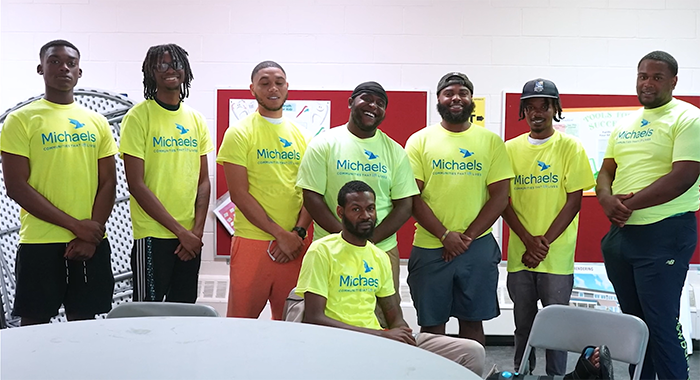
Nekoumand said schools can’t bear all the burden. “I think exposure is key here, and I’m not completely convinced it’s all on the education system to create all these opportunities. I think it needs to be a collaborative effort.”
“I speak to a lot of college-age students, and I think our industry is … especially if you’re building on the more technical core markets, one of the most recession proof industries and opportunities to grow within an organization,” he continued. “And so I think the more you’re able to develop training programs and partnerships and get the next generation exposed to this sustainable workforce and the opportunities for career growth, I think is really, really important.”
Adopting new technology
Smith and Kuskin both said they hope adopting new technology will make the field more appealing to young people.
“I’m optimistic that with all the new technology and sort of the older generation phasing out, the newer generation coming in, there’ll be a lot of opportunities there to attract the younger generation that may not otherwise be drawn into the construction world because of all the technology that’s there and cool,” Kuskin said.
That does align with career preferences of younger generations. According to a recent McKinsey report, “Contrary to all other age groups, Gen Z prioritizes career development and advancement potential as their top factors.”
I’m optimistic that with all the new technology … there’ll be a lot of opportunities there to attract the younger generation that may not otherwise be drawn into the construction world because of all the technology that’s there and cool
– Josh Kuskin, Rockefeller Group
Nekoumand agreed he thought adopting and introducing new technology could help supplement some of the concerns raised. It also makes good sense for current workers and the business. “We utilize robotics, prefabrication, digital tools — those elements really help our teams and all the stakeholders, really think differently, think in a safer manner and actually smarter when we look at how we build.”
No matter the size or scope of a project, Nekoumand said his team looks for opportunities for modularization and prefabrication. This effort streamlines the process and ensures more consistent working conditions for employees — “so they’re not working out in the cold or the heat,” for example.
“We think AI is definitely going to have a component in this, but we do believe there’s a whole human side that is never going to leave our industry,” he noted.
Kuskin lamented a common concern that the construction industry has lagged behind others when it comes to adopting new technologies. He’s hopeful that tools like AI can help make an impact – but sees issues with adoption. “All the software and the drone type stuff that we see now has certainly helped, but one of the things that I’ve observed is not everybody’s using it,” Kuskin said.
Smith agreed. She said subcontractors, in particular, are sometimes slow to adopt or understand new tools.
“There’s so much waste in the traditional construction process that we can drive out by just trying to ask ourselves how do we do things differently?” Ciminelli said. He noted how using three-dimensional models can help with the “proverbial measure twice, cut once” adage.

His firm is also trying to use the tech as a visual planning tool.
“And getting into not just drone for capture, but anything that’s got a computer provision component where we can digest what it sees and then give us information back about what’s been done: whether it’s in the right spot, what’s our progress we week over week. There’s a tremendous amount of power there that we have just scratched the surface on,” Ciminelli said.
Smith agreed that approaching jobs better prepared – whether that’s coming in “with full built walls” – has and can help create efficiencies. And that’s important, because it’s all about delivery.
“Hopefully pricing is going to come down a little bit, but … on the labor side it’s going to go up sooner. I mean, what does the developer want the most? Let’s get this thing built so we can start making money. Same with my interior clients that I do all the interior fit outs.” Smith said wrapping up sooner is key, because clients can collect their money sooner. “So, on the technology side, we need to get more innovative and doing more prefab stuff, more kits you want to call it and then put ’em together.”
In addition to price points for new technology, change is hard and seemingly presents the biggest hurdle for the industry to get out of its own way.
“And so we’ve been doing it the way so long the same way. And that’s everything from how the trades execute their work to how it gets planned to even how it gets procured … All of it’s just been locked in the same method for so long.
“ To try and just inject something that feels new can completely disrupt the entire workflow [and] is a bit of a culture change that is going to take some time to really kind of mold into something that looks, I think will look very, very, if we’re talking about five to seven years from now, different compared to what it is today,” Ciminelli said.