Sign In
Upcoming Event
 Free Newsletter


PHOTO: DEPOSIT PHOTOS
PHOTO: DEPOSIT PHOTOS
New Jersey hospitals turn to AI to advance heart care
Martin Daks//August 24, 2026//


The basics:
- Hospitals are using AI to improve cardiac imaging, diagnosis, treatment planning
- Remote monitoring, predictive tools are expanding access to preventive heart care
- Rising costs, coverage gaps remain challenges for cardiovascular patients
A patient recently entered The Valley Hospital with an undetected, high-risk “widow maker” lesion – a severe blockage – in their left main artery, according to Valley Director of Cardiac Imaging Dr. Himanshu Gupta.

“It’s the kind of blockage that can be missed even on invasive angiography,” he said, referring to a standard exam procedure where a doctor threads a catheter through an artery to the heart to find blockages. But HeartFlow’s PCI Navigator – an AI-driven pre-procedural planning tool used by the hospital, part of Valley Health System – flagged the lesion’s location and severity from CT (computed tomography) data in advance, letting the physician plan precisely for a successful procedure.
“The physician later told me that, without that added information, it is likely the potentially fatal lesion could have gone undetected,” said Gupta, who also serves as a director of Valley’s cardiovascular fellowship program, which is sponsored by the Icahn School of Medicine at Mount Sinai and will welcome the inaugural class of fellows next year.
AI reshaping heart care
Through its early adoption of PCI Navigator – which was introduced in 2025 but only became commercially available earlier this year – Valley has become a proving ground for the way artificial intelligence can reshape cardiac diagnosis and treatment.
Part of the HeartFlow One platform, PCI Navigator generates a patient-specific 3D model combining coronary anatomy, plaque composition and lesion physiology to optimize stenting before a patient enters the cardiac catheterization laboratory. Valley says it was the first hospital in the country to use the platform outside a clinical trial setting — a milestone reflecting years of groundwork: “We have been using HeartFlow since 2019,” according to Gupta.

The technology “provides us with advanced diagnostic accuracy,” added Valley Director of Cardiac Catheterization Laboratory and Structural Heart Program Dr. Rajiv Tayal. “While interventional cardiologists nationally correctly predict the need for intervention roughly 50% to 60% of the time, our own accuracy, aided by CT-based planning, now runs in the 90th percentile.”
The AI-driven platform has also changed cath lab workflow. Instead of discovering complications mid-procedure, Tayal said his team can now anticipate which cases will require advanced techniques like calcium-modification tools, letting them plan their days more efficiently. “You walk into the room having almost what’s analogous to a diagnostic angiogram in front of you, so you have a plan going into the procedure,” he said.
Tayal said the technology can be especially valuable for women, “who often present with subtler symptoms compared to men – fatigue or shortness of breath rather than classic chest pain – which makes cardiovascular disease harder to catch early.”
A business break?
AI in medicine can also have commercial benefits. Consider how, for small or medium sized business owners, a mid-afternoon “doctor’s appointment” often means a chunk of the workday gone, sometimes for a question that could have otherwise been answered in minutes. Atlantic Health is betting that a new AI tool can shrink that lost time.
The Morristown-based health system has teamed up with K Health, a New York-based AI-enabled care company, to launch Atlantic Health PatientGPT, which the system calls New Jersey’s first AI-powered “digital front door” to care.
Unlike a general chatbot, PatientGPT is tied into Atlantic Health’s electronic health record and MyChart patient portal, so it can weigh in on symptoms using a patient’s actual medical history — then route them to the right next step, whether that’s self-care advice, a same-day virtual primary care visit or an in-person appointment.
For employers, particularly smaller businesses without on-site occupational health or a robust benefits navigation team, the pitch is speed and precision. Rather than missing hours to sit in urgent care for something minor – or, worse, ignoring a symptom that needed attention – the tool is designed to sort that out in a few taps from a phone.
The best use of AI in healthcare makes care more human, not less.
– Saad Ehtisham, Atlantic Health president and CEO

“The best use of AI in healthcare makes care more human, not less,” Atlantic Health President and CEO Saad Ehtisham announced. “Technology should strengthen the connection between patients and clinicians, reduce barriers to care, and help people get the right care at the right time.”
K Health co-founder and CEO Allon Bloch framed it as a shift in how patients reach medicine at all — routine or complicated. In an announcement, company co-founder Ran Shaul was blunter about what has to come first for any of it to matter. “Trust is the whole game in clinical AI,” Shaul said. “Patients and clinicians have to know the technology is safe before it can be useful.”
The tool is rolling out gradually in a beta phase over the coming months, and Atlantic Health is emphasizing that it’s a supplement to physician care, not a replacement. K Health, which has raised more than $400 million in venture funding since 2016, already powers similar platforms at health systems including Northwell Health, Hackensack Meridian Health and Penn Medicine.
As business owners watch healthcare costs and absenteeism climb, this may be a small but telling signal: AI in the exam room could end up being as important for the balance sheet as for the patient.
Business model
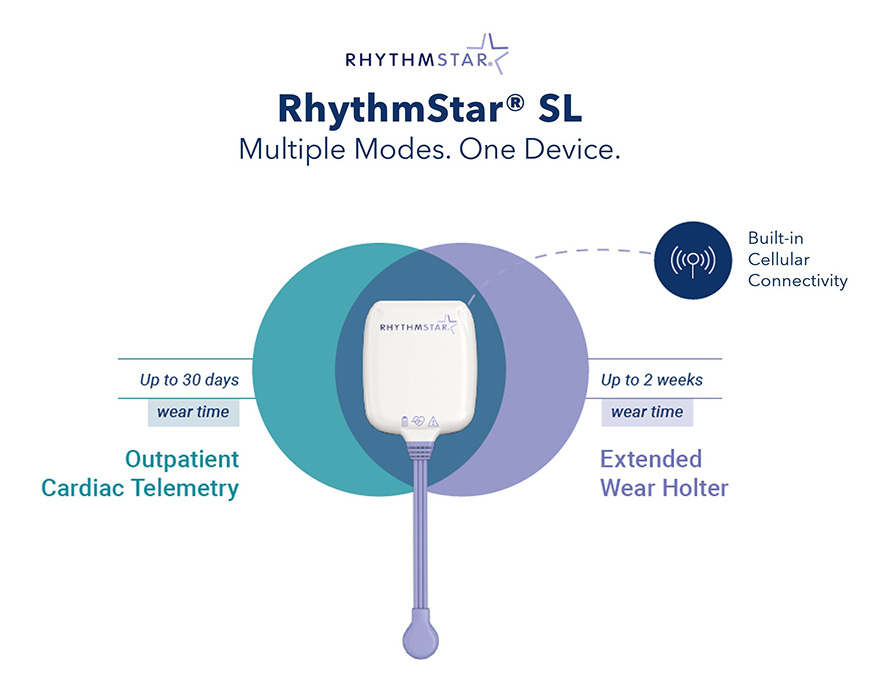
There’s a case study for that could point to where healthcare dollars are heading next: RhythMedix is showing how a cardiovascular diagnostic company can turn artificial intelligence into a scalable, expanding market — without letting the algorithm steal the show.
The company’s core offering, the RhythmStar SL cardiac monitoring system, is RhythMedix’s third U.S. Food and Drug Administration-cleared product since its 2013 founding. It pairs with the company’s proprietary Augmented Arrhythmia Intelligence platform, which processes every single heartbeat transmitted from individual patients – while supporting thousands of patients simultaneously – through its highly secure, cloud-based system before human monitoring technicians verify the results.
“It’s not a full reliance on automation,” said RhythMedix President and CEO Brian Pike. “It’s a healthy relationship between artificial intelligence and automation, coupled with oversight from clinicians. That’s our secret sauce.”

Pike said internal testing puts AAI’s raw accuracy in the “mid-90% range” across all arrhythmia types but, to ensure closer to 100% accuracy, the company deliberately keeps clinicians in the loop, rather than fully automating diagnosis.
From a business standpoint, Pike said the model is built for expansion on multiple fronts. RhythMedix sells directly to physician practices and hospital systems – no distributors – through a national sales team and has amassed roughly 30,000 unique prescribing physicians since inception. The company employs about 300 people, mostly at its Mount Laurel headquarters, and has expanded its footprint to all 50 states with Pike pegging year-over-year headcount and patient service growth at roughly 20%.
Strategy shift
That expansion is increasingly driven by a shift in strategy: Moving beyond diagnosing symptomatic patients toward what Pike called a “targeted diagnostics” approach — identifying at-risk but asymptomatic patients before a catastrophic event like a stroke occurs.
Recognition
Hackensack Meridian Health recently became the first health system in the U.S. certified by The Joint Commission for responsible use of AI across clinical patient care and operations. Find out more here.
The company is also expanding into longer-term monitoring of patients with cardiac implantable electronic devices, or CIEDs — a natural continuation for patients who first arrive on short-term monitors and later need pacemakers or defibrillators. “Once you get one of these therapeutic devices, you always have a therapeutic device,” Pike noted, underscoring the critical clinical need to monitor that patient population.
Underpinning the growth has been sustained investment: RhythMedix still directs roughly 25% of revenue back into R&D. Nearly three years ago, the company took a majority investment from Nashville and Dallas-based Pharos Capital Group, a healthcare-focused private equity firm focused on expanding remote care into underserved and rural markets.
One headwind is reimbursement pressure, with Medicare and private payer rates for testing trending south. But Pike argues that RhythMedix’s efficiency gains from AAI, combined with a high diagnostic yield – more than half of tests confirm an arrhythmia – help offset that pressure while delivering savings to the broader healthcare system.
Looking ahead, Pike said RhythMedix expects to bring two additional products to market by early next year, along with continued device miniaturization and deeper data-sharing partnerships with integrated delivery networks.
He says this is a market “that’s still very much in expansion mode.”
Coverage gaps

As deductibles climb and some patients drop coverage altogether, Virtua is watching a warning sign emerge: delay. “With uncertainty comes the possibility that people may delay preventive care, follow-up appointments, testing, or treatment because of financial concerns,” cautioned Dr. Ibrahim Sultan, vice president of clinical operations for Virtua’s cardiovascular service line. “From a cardiovascular perspective, this can be devastating.”
The risk, Sultan explained, is that a condition manageable in an outpatient setting can quietly progress into a heart attack, stroke or heart failure requiring emergency hospitalization — a far costlier outcome for patients and the health system alike.
Hospitals provide emergency care regardless of insurance plans or a patient’s ability to pay, but Virtua’s response leans on triage before crisis: pointing patients toward billing assistance, insurance enrollment help and charity care programs before symptoms escalate. “A lack of insurance should never prevent someone from seeking evaluation for potentially serious cardiac symptoms,” Sultan said.
His broader advice to SMB owners and their employees: don’t skip the primary care visit. “They can help patients manage chronic conditions, enabling people to avoid emergency room visits and hospitalizations,” Sultan noted. He called it a preventive habit that protects both health and household budgets.