Sign In
Upcoming Event
 Free Newsletter

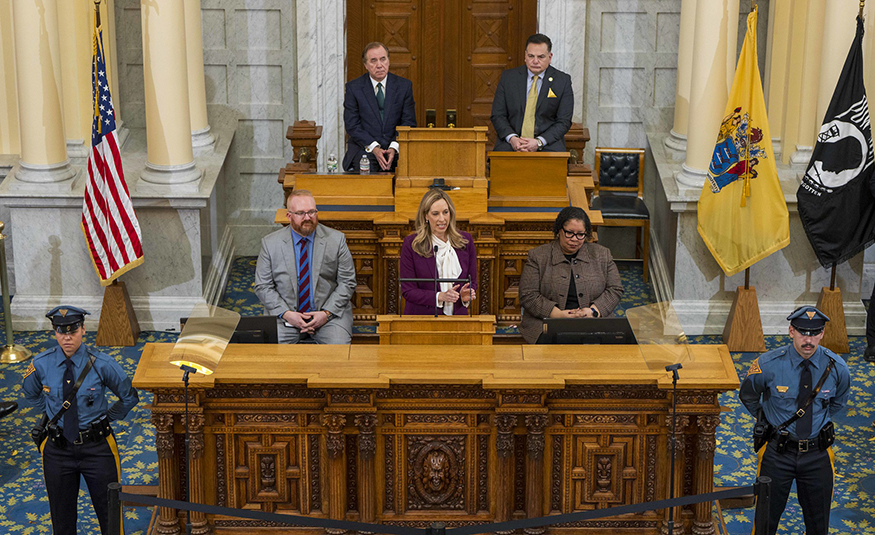
Gov. Mikie Sherrill gives her first Budget Address in the Assembly Chambers of the State House in Trenton on March 10, 2026. - PROVIDED BY THE NJ GOVERNOR'S OFFICE/TIM LARSEN
Gov. Mikie Sherrill gives her first Budget Address in the Assembly Chambers of the State House in Trenton on March 10, 2026. - PROVIDED BY THE NJ GOVERNOR'S OFFICE/TIM LARSEN
FDU poll: Sherrill budget avoids unpopular cuts
Matthew Fazelpoor//April 2, 2026//


The basics:
- FDU poll shows voters oppose most spending cuts, tax increases
- Sherrill’s $60.7B New Jersey budget avoids least popular cuts
- Large majorities oppose reducing pension payments, NJ Transit funding
- 67% support eliminating state subsidies to Rutgers football
A new Fairleigh Dickinson University poll finds Gov. Mikie Sherrill’s proposed budget largely avoids the most unpopular spending cuts and tax increases, even as voters show little appetite for most cost-cutting measures.
The survey took place conducted March 20–28 among 805 registered New Jersey voters. It has a margin of error of +/- 3.4% (or +/- 3.9% including weighting effects).
Voters broadly oppose most spending cuts and revenue increases tested in the poll.
NJBIZ has extensively reported on Sherrill’s $60.7 billion budget proposal. The plan includes cuts in some areas, revenue raisers that have drawn concerns from business leaders, along with record school funding, a full pension payment, record property tax relief and more.

“Balancing the budget means cutting spending and increasing revenue, and voters don’t tend to like either of those,” said Dan Cassino, a professor of government and politics at FDU and the executive director of the FDU Poll. “But some cuts are more acceptable than others, and the governor’s proposal seems to be dodging the least popular options.”
Among the proposals included in the governor’s budget, none receive majority support, but some are less unpopular than others. Charging a fee to businesses whose employees rely on state-funded health care is nearly evenly split (47% support, 49% oppose), while cutting support for public colleges and universities draws more opposition (40% support, 59% oppose).
At the same time, the budget avoids some of the least popular options surveyed. Large majorities oppose reducing pension payments (26% support, 71% oppose) and cutting NJ Transit funding (33% support, 64% oppose).
‘Not in the mood’ for more cuts
Cassino noted how past governors have balanced the budget on the back of cuts to the pension plans and NJ Transit. “It looks like voters have seen the outcomes of those cuts, and are not in the mood for more of them,” he said.
Decreases to local school funding are also highly unpopular – with just 26% support and 72% opposition, even as the state debates how funding changes will affect individual districts.
Political differences are evident throughout the results. Republicans are more supportive of higher education cuts (59% support, 38% oppose) and somewhat more open to reducing NJ Transit funding (42% support, 53% oppose). Democrats generally oppose most cuts but show relatively higher support for reducing senior property tax rebates (41% support, 57% oppose), also known as StayNJ. The proposed budget would reduce StayNJ funding by some $500 million.
Another item business groups are critical also divides voters. The proposal would charge businesses with 50 or more employees a fee based on how many employees are enrolled in the state health care system. The poll found 47% supported it, while 49% opposed. Among party lines, it received 51% support from Democrats and 41% support from Republicans.
To voters, charging businesses whose employees are getting health care from the state may feel more like restoring fairness than increasing taxes.
– Dan Cassino, executive director, FDU Poll
“Increases in taxes or fees are never popular, but some are more palatable than others,” said Cassino. “To voters, charging businesses whose employees are getting health care from the state may feel more like restoring fairness than increasing taxes.”
In agreement
The only proposal to receive clear majority support is cutting state subsidies to Rutgers football.
The program received some $40 million from the state in the last few years of the Murphy administration, according to NJ.com. That’s in addition to hundreds of millions in student athletic fees and other spending from the university.
Since Rutgers joined the Big Ten in 2014, it has had just three winning seasons. Additionally, the overall athletic department has amassed a major budget deficit as the school has integrated into the conference.

Overall, 67% of voters support eliminating that funding, compared with 31% who oppose it — making it the only item tested by pollsters with net positive support across the electorate.
“At a time when belts are tightening everywhere, it’s hard to justify tax dollars being spent to support a college football team,” Cassino said. “But voters might be happier about the subsidies if they were winning more games.”