Sign In
Upcoming Event
 Free Newsletter

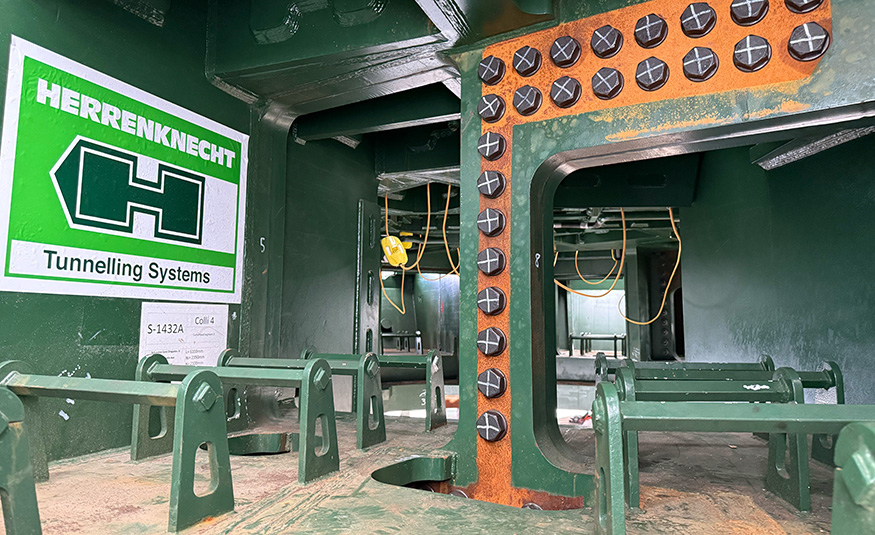
The Gateway Development Commission provided a media tour April 13, 2026, of progress on the Hudson Tunnel Project. Shown here is the cutter head of tunnel boring machine, which will cut through the rock. - MATTHEW FAZELPOOR/NJBIZ
The Gateway Development Commission provided a media tour April 13, 2026, of progress on the Hudson Tunnel Project. Shown here is the cutter head of tunnel boring machine, which will cut through the rock. - MATTHEW FAZELPOOR/NJBIZ
Hudson Tunnel Project nears TBM phase in North Bergen
Matthew Fazelpoor//April 27, 2026//


 Listen to this article
The basics:
- Tunnel boring machines are being assembled in North Bergen for Hudson Tunnel Project
- Palisades segment will mark the start of active tunneling phase
- Machines will bore 1-mile tunnel toward Weehawken
- Project part of Gateway Program to expand rail capacity
Work on the Hudson Tunnel Project is entering a pivotal new phase in North Bergen, where massive tunnel boring machines are beginning to take shape along a busy stretch of Tonnelle Avenue — signaling tangible progress on one of the most consequential infrastructure projects in the region.
During a recent media tour, officials offered a behind-the-scenes look at the Palisades Tunnel segment, where early-stage construction is transitioning into preparations for active tunneling. The site, anchored by a deep shaft just off Tonnelle Avenue, is a central hub for the project. It serves not only as the launch point for the tunnel boring machines (TBMs), but also as a key node for excavation, material removal, ventilation and overall logistics.
“One of the current important milestones we have ahead of us is one the start of the boring operation in the Palisades,” said James Starace, chief of program delivery for the Gateway Development Commission.
Set against the backdrop of constant traffic and dense development, the activity unfolding at the site represents a different kind of movement — one that will soon extend far beneath the Palisades, carving out a new rail link designed to transform connectivity between New Jersey and New York City.
Putting the pieces together
Across the Tonnelle Avenue site, crews are operating on multiple fronts simultaneously. A massive rock “launch box” – essentially the underground chamber from which the TBMs will begin their journey – remains under excavation. Just feet away, teams are carefully assembling the enormous machines that will soon begin boring through solid rock.
The work is highly coordinated, blending heavy construction with precision engineering. Dozens of workers move between tasks, navigating cranes, steel components and reinforced structures, all while adhering to tight tolerances required for the TBMs to function properly once underground.
The machines themselves were designed by Herrenknecht AG, a Germany-based firm known globally for producing some of the most advanced tunneling equipment in operation today. Each TBM arrived onsite in nearly 100 separate components, requiring a meticulous, piece-by-piece assembly process that is now well underway. More than 50 workers are currently dedicated to that effort, gradually transforming the scattered parts into two fully operational machines that will soon anchor the next phase of the project.

Once complete, each TBM will weigh approximately 1,700 tons and stretch close to 500 feet in length — roughly the size of one-and-a-half football fields. Designed specifically for the geological conditions of the Palisades, the machines are engineered to cut through dense rock while maintaining structural stability and precision alignment.
At the core
At the heart of each TBM is the main drive system, often described by engineers as the machine’s core. Weighing between 175–180 tons, the drive system is powered by 11 hydraulic motors that rotate the cutter head — the circular front section responsible for grinding through rock.
Those cutter heads, currently being assembled under protective coverings, are outfitted with approximately 59 cutter wheels. Welding and assembly are conducted in controlled environments to ensure the integrity and durability of each component, given the extreme pressures the machines will face once operational.

When activated, the TBMs will function as fully integrated underground systems. As they advance, they will cut through rock, transport excavated material via conveyor systems and install precast concrete segments to form the tunnel lining — all in a continuous, synchronized process.
“It’s an all-encompassing piece of equipment that cuts the rock, moves the rock, installs a liner and pushes itself forward,” said Starace.
That process – often described as cut, remove, line and push – is expected to progress at a pace of roughly 30 feet per day. At that rate, officials estimate it will take about a year to complete the approximately 1-mile tunnel segment running through the Palisades toward Weehawken.
Once that stretch is finished, the machines will be extracted at a receiving shaft, marking the completion of this phase and paving the way for the next stage of the broader Hudson Tunnel Project.
“This marks the start of tunneling,” Starace said.
Next steps
From there, a separate set of TBMs – designed for softer ground conditions – will take over for the next leg of the journey, continuing beneath the Hudson River toward Manhattan’s West Side.
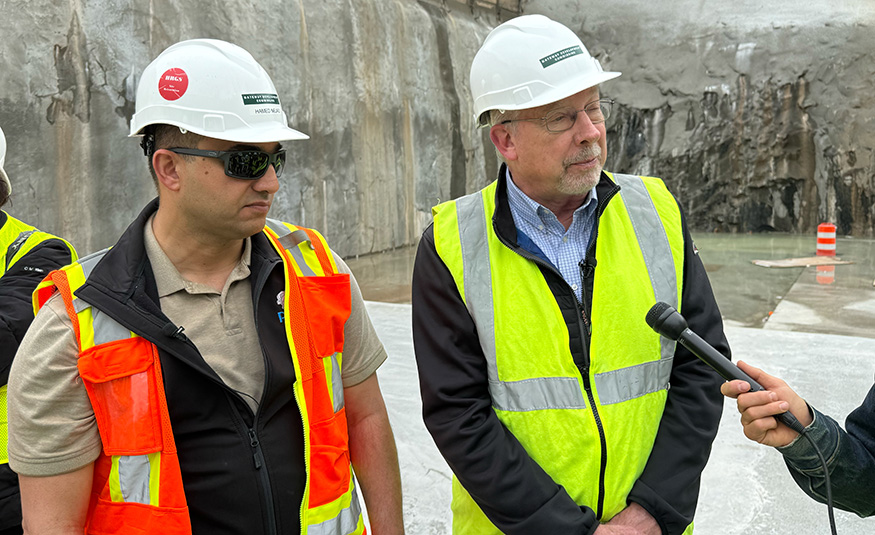
“We’re still in construction making this,” said Gateway Development Commission Chief Engineer Hamed Nejad. “They go a mile, and they come out that Hudson County shaft at Weehawken. And then they go on their journey.”
He noted a key difficulty of this phase of the project. “One of the challenges of a TBM, you always have to have spare parts. And one of the spare parts because you’re going to go through a lot of them is these cutter wheels,” Nejad explained. “The contractor has a projection based on the rock, how much they need. So, they have it in a storage unit on site.”
The Palisades Tunnel segment represents a crucial early piece of the broader Gateway Program, a long-planned effort to modernize and expand rail capacity between New Jersey and New York. The new tunnels are intended to supplement and eventually relieve the aging infrastructure currently carrying rail traffic under the Hudson River — infrastructure that dates back more than a century and has been significantly strained in recent years.
Keeping things moving
Officials have repeatedly emphasized that the stakes are high, not just for commuters but for the regional and national economy, given the corridor’s importance as one of the busiest rail routes in the country.
In the months ahead, activity at the Tonnelle Avenue site is expected to intensify. Crews will continue excavating the launch box while finalizing TBM assembly and conducting extensive testing to ensure the machines are fully operational before tunneling begins. Once active, a crew of approximately 30 to 40 workers will operate each TBM, managing everything from navigation and cutting operations to material handling and system monitoring.
See a virtual tour of the Hudson Tunnel Project, courtesy of GDC:
During the tour, reporters asked officials about the impact of the federal funding freeze that led to a pause in construction earlier this year and what it meant for the project’s trajectory. Starace acknowledged the disruption but emphasized that work has continued to advance – not just in North Bergen, but across the broader project footprint – which currently includes five active construction sites spanning New Jersey, New York and the Hudson River.
Background
See the latest in the Hudson Tunnel Project legal battle as well as a timeline of the funding freeze here.
“First of all, we’re analyzing the impact of the funding pause,” Starace told reporters. “Everything we do is about keeping on schedules and looking at mitigations. But it’s still under analysis. We’re working closely with our partner in the FTA [Federal Transit Administration] and the USDOT [U.S. Department of Transportation]. We’re continuing communicating with them.”
Regaining momentum
Starace was asked if the funding freeze and pause of work caused any hiccups in getting back up to work. “You can’t build a project that starts and stop,” he explained. “The pause had a lead-in, and it had a rebuild on it, once we started again. But yes, everyone’s back to work now, and we’re regaining the momentum we lost.”
As the TBMs near completion and the launch site takes shape, officials say the focus remains on execution — ensuring that the next phase of tunneling begins on solid footing.
Starace added, “That’s why this is such a carefully coordinated program. Because each piece, each project in the program, is dependent on the others.”