Sign In
Upcoming Event
 Free Newsletter

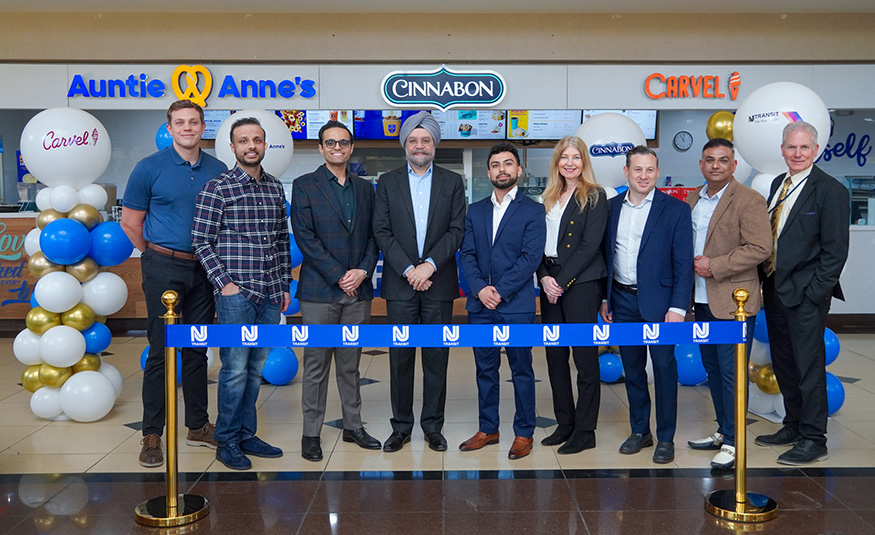
Officials and stakeholders celebrate the addition of new food options at Secaucus Junction, including Auntie Anne’s Pretzels, Cinnabon and Carvel Ice Cream. - PROVIDED BY NJ TRANSIT
Officials and stakeholders celebrate the addition of new food options at Secaucus Junction, including Auntie Anne’s Pretzels, Cinnabon and Carvel Ice Cream. - PROVIDED BY NJ TRANSIT
NJ Transit adds new dining options at 3 stations
Kimberly Redmond//April 20, 2026//


 Listen to this article
New food and beverage options are rolling into NJ Transit rail stations in Secaucus, Newark and Maplewood.
According to the public transportation agency, the added tenants at Secaucus Junction are Auntie Anne’s Pretzels, Cinnabon and Carvel Ice Cream.
Over at Newark Penn Station, Zaro’s Family Bakery recently completed a major overhaul that added fresh-casual chain Freshens to its space. Home Slice Pizza also began serving customers just down the main concourse, NJ Transit said.
Commuters passing through Maplewood Station can now stop in at a shop run by General Store Shops & Cafe for a fresh-brewed cup of Montclair-based roastery Paper Plane Coffee, snacks and baked goods.
Now LAND-ing
Commenting on the additions, NJ Transit Senior Vice President of Real Estate Gagandeep Singh said, “These exciting tenants at our key stations are another way NJ Transit is working to enhance the commuting experience for customers, by providing high quality options along their journey.”
Adding more dining options aligns with NJ Transit’s strategy to generate additional revenue beyond ticket sales, he said. “This is another example of NJ Transit’s efforts to meet the travel needs of every customer, while also utilizing its assets to support non-farebox revenue.”
Singh went on to say the tenants at the three stations are representative of opportunities throughout NJ Transit’s 8,000-acre commercial real estate portfolio.
As part of the Leveraging Assets for Non-Farebox Dollars Plan, the agency aims to raise as much as $1.9 billion in non-farebox revenue over the next 30 years. The LAND plan aims to leverages underutilized real estate assets. If successful, the strategy could generate as much as $14 billion for the state as well as $1.6 billion for municipalities during that time period.
NJ Transit has touted the first-of-its-kind plan as a way to strengthen communities around stations while improving customer service and reliability.