Sign In
Upcoming Event
 Free Newsletter

Officials detail NJ World Cup plan centered on public transit
Meadowlands Chamber 'Eggs & Issues' breakfast tackles transportation, mobility
Matthew Fazelpoor//May 5, 2026//
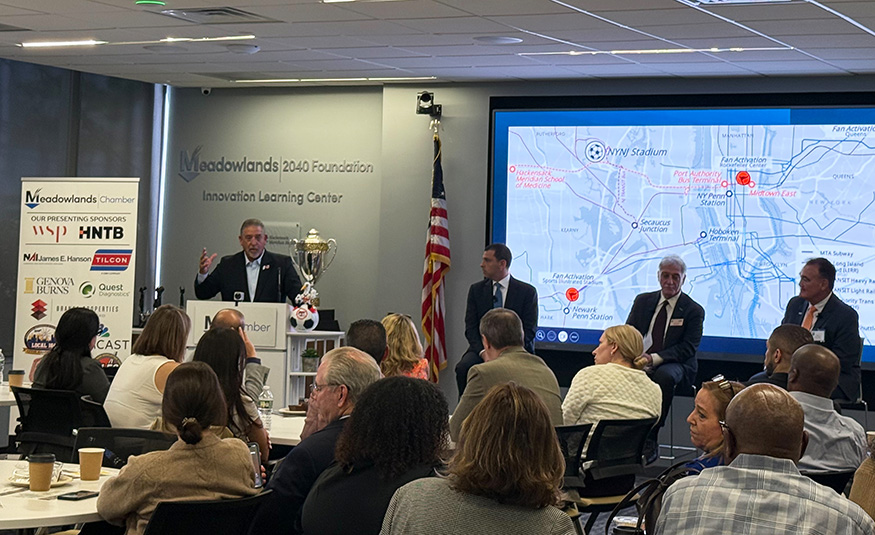
The Meadowlands Chamber hosted its "Eggs & Issues: Transportation and Mobility" event May 1, 2026, at the organization's Lyndhurst headquarters. The discussion included an expert panel on the future of transportation, just in time for the FIFA World Cup 2026. - MATTHEW FAZELPOOR/NJBIZ
The Meadowlands Chamber hosted its "Eggs & Issues: Transportation and Mobility" event May 1, 2026, at the organization's Lyndhurst headquarters. The discussion included an expert panel on the future of transportation, just in time for the FIFA World Cup 2026. - MATTHEW FAZELPOOR/NJBIZ
Officials detail NJ World Cup plan centered on public transit
Meadowlands Chamber 'Eggs & Issues' breakfast tackles transportation, mobility
Matthew Fazelpoor//May 5, 2026//


The basics:
- Officials double down on strict ‘transit-first’ strategy — warn private cars slower, less reliable
- Kolluri defends $150 rail pricing, says commuters won’t subsidize World Cup travel costs
- Leaders warn walking to MetLife Stadium is unsafe and illegal, pushing back on fan speculation
- Businesses raise concerns about access, deliveries, employee commuting during match-day congestion
Already the most scrutinized piece of the 2026 FIFA World Cup in the New York/New Jersey region, transportation took center stage at the Meadowlands Chamber‘s “Eggs & Issues: Transportation and Mobility” event May 1 in Lyndhurst.

Officials and industry leaders detailed a tightly controlled, transit-first plan while acknowledging the challenges it presents for fans and businesses alike. “We’re really excited. There is some uncertainty in the marketplace about World Cup, and I’m going to tell you that there shouldn’t be. This is an amazing opportunity for us,” said Jim Kirkos, Meadowlands Chamber president and CEO.
The event featured keynote speaker Kris Kolluri, president and CEO of NJ Transit and executive director of the New Jersey Turnpike Authority, alongside panelists Alex Lasry, CEO, FIFA World Cup 26 NYNJ Host Committee; Dan Baer, senior vice president, WSP; and Dennis Martin, associate vice president, HNTB.
As NJBIZ has reported, the region’s World Cup mobility plan calls for moving roughly 40,000 fans per match primarily via NJ Transit rail service, supported by dedicated bus shuttles.
Moving 40K people
Kolluri emphasized both the opportunity and the scale of the assignment.
“This is a suburban area that happens to have an amazing stadium with amazing transportation assets,” said Kolluri. “But we needed to think about how to move 78,000 people from New York and other parts of New Jersey to this facility safely and efficiently.
“So, New Jersey Transit took on this responsibility of providing transportation for 40,000 people. Just to give it a perspective that is 20,000 people more than we’ve ever moved.”
Key elements include $150 round-trip rail tickets and $80 shuttle options, both tied to match attendance, along with a strict no-parking policy for spectators at MetLife Stadium. Limited, advance-purchase parking is also available at American Dream.
Service will begin four hours before kickoff and run for three hours after matches. The agency will restrict rail access temporarily to ticketed fans during peak ingress and egress periods. Officials say they will limit ride hailing to a designated drop-off zone at the Meadowlands Racetrack, with no direct vehicle access to the stadium itself.
Don’t walk this way
Kolluri also addressed criticism of the ticket pricing structure. He framed it as necessary to avoid burdening everyday commuters.
“Yes, it’s $150 a round trip, but let me explain why that is important,” he said. “I think that the governor’s statement that New Jersey commuters are not going to subsidize the travel of fans actually makes sense if you step back and think about it for a second.
“The governor’s perspective is this is an experience for the fans, and we want to make sure there’s a good transportation system, and that cost to run the system for the eight games is $6 million a game – or $48 million for the eight games.”
[T]hat cost to run the system for the eight games is $6 million a game – or $48 million for the eight games.
—Kris Kolluri, president and CEO, NJ Transit
The scale and scope of this event has required a complex planning process for security and transportation, which remains the defining challenge — along with a growing source of debate among fans. Officials addressed online chatter suggesting attendees might try to walk to the stadium to avoid steep transit costs, pushing back strongly on both safety and legality.
“Walking is the worst thing you can ever do in this environment,” Kolluri said. He emphasized the goal is for fans to enjoy the event “and not risk it.”
“It’s also illegal to walk to MetLife Stadium,” Lasry added. “It’s not safe, but it’s also illegal.”

Kolluri reinforced that message. He stresses the limits of capacity and the need for structured movement.
“I don’t have a magic solution. You should expect the volume to be very heavy, about 40,000 people in two hours, two-and-a-half, three hours is a lot of people to process,” he said. “If I had a magic carpet to give you, I would give you one. I don’t; but I do have a good transportation service to provide that I think is safe and it will be efficient.”
‘A public transit event first’
Questions from Chamber members and local businesses in attendance underscored the complexity of executing the plan beyond just moving fans.
Attendees raised concerns about private transportation providers being largely excluded, hotel guests struggling with last-mile access despite proximity, employee commuting during match windows and potential disruptions to deliveries from anticipated congestion comparable to major emergency situations or severe weather events.
Don’t have tickets?
Here are other parties planned around the state:
- Hoboken plans 12 days of World Cup block parties
- Newark launches FIFA World Cup 2026 fan campaign
- Photos: American Dream unveils 39-day World Cup Dream Fan Fest
- The Yard to host New Brunswick World Cup watch parties
Lasry acknowledged those concerns but reiterated the core message.
“The fastest and most efficient way to get to the stadium is going to be public transit – plain and simple, full stop,” said Lasry. “If you are trying to get there in a fast and efficient manner, it’s going to be New Jersey Transit or our bus shuttle. I can’t guarantee the speed and efficacy of how to get there if you arrange your own private car or take any other mode of transportation. That is not to say that people can’t do that if they don’t want.
“But as I said, this is a public transit event first – and the way that I can guarantee the fastest and most efficient way to get there is going to be public transit, which is why I will be making sure that I am taking public transit to the game.”
Whole different (foot)ball game
Officials also pushed back on allusions to the troubled 2014 Super Bowl. They say the region is better prepared this time around.
“This is not comparable to the Super Bowl. And I would recommend we all try to get over the PTSD from the Super Bowl,” said Lasry. “This is going to be way different. And the Super Bowl was 10-plus years ago. We’re in a much different media environment. We’re in much different sports and entertainment environment. And New Jersey is in a much different place than it was 10-plus years ago.”
Kolluri echoed that sentiment, describing the event as an amazing opportunity to demonstrate the state’s capabilities on a global stage.
“This is an extraordinary opportunity for the region. This is an extraordinary opportunity for the State of New Jersey,” said Kolluri. “We will shine, and we will show the world what we are made of.”
Officials expect to release a broader communications rollout in the coming weeks to clarify logistics and provide guidance for businesses and residents.
“I want all of us to be excited. I want all of us to know that the governor is excited about it,” said Kolluri. “We are excited about it. We’re capable. We’re willing.
“We think this is an opportunity to once and for all show that we as a state are not only capable of hosting these kinds of mega events – that we are actually excited about doing that.”