Sign In
Upcoming Event
 Free Newsletter


Rutgers University's Redwing autonomous underwater vehicle departed off the coast of Martha’s Vineyard Oct. 10 for a journey around the world. The vehicle is described as the most advanced subsea glider ever developed and is designed to become the first underwater robot to complete a circumnavigation. - PROVIDED BY TELEDYNE MARINE
Rutgers University's Redwing autonomous underwater vehicle departed off the coast of Martha’s Vineyard Oct. 10 for a journey around the world. The vehicle is described as the most advanced subsea glider ever developed and is designed to become the first underwater robot to complete a circumnavigation. - PROVIDED BY TELEDYNE MARINE
Rutgers, Rowan drive major engineering innovation in NJ
Jessica Perry//October 27, 2025//


 Listen to this article
The basics:
- Rutgers and Teledyne Marine launch Redwing, the world’s first underwater robot to circle the globe
- Redwing collects real-time ocean data to improve climate projections
- Rowan University, NARTP and ACEA form an aerospace innovation consortium
- Initiative will focus on aviation technology, safety and workforce development
The Roundup: Significant engineering developments from around New Jersey:
Redwing
Teledyne Marine and Rutgers University recently set underwater robot Redwing on its inaugural journey around the world as it seeks to set a new record.
Launching into the Atlantic Ocean, the autonomous underwater vehicle departed off the coast of Martha’s Vineyard in Massachusetts Oct. 10.
The deployment kickstarts a five-year mission for Redwing, described as the most advanced subsea glider ever developed, to become the first underwater robot to circumnavigate the globe.
The next-generation Slocum Sentinel Glider will collect data, evade fishing nets and ride ocean currents – all without a human passenger. According to the partners, the mission aims to inspire next-gen robotic engineers.
“These will deliver early warnings of extreme weather and will track the impact of shifting ocean currents so that we can refine long-term climate projections in a way that scientists have dreamed of for decades,” noted Teledyne Marine Chief Operating Officer Brian Maguire.
Oscar Schofield heads the Rutgers team with fellow oceanographer Scott Glenn. He said the mission would offer another tool “to achieve real understanding.”
Faster and more powerful than its predecessors, Redwing features a carbon fiber hull. The glider moves by adjusting its buoyancy, as opposed to a propeller. The sinking and rising zigzag pattern conserves energy, according to the team behind it.
Symbolism
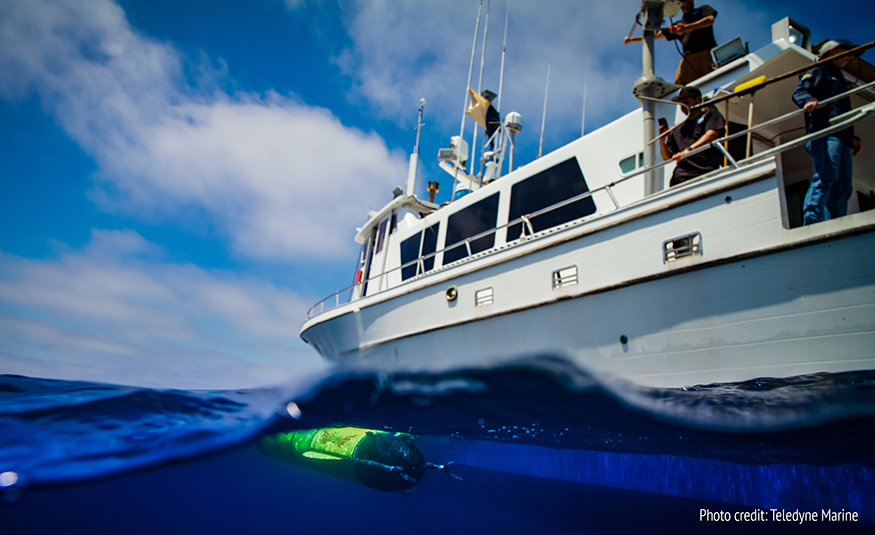
The glider’s name is an acronym for Research and Education Doug Webb Inter-National Glider. It recognizes RU’s school color, scarlet, as well as memorializing the late Doug Webb. Webb invented the Slocum glider and founded Teledyne Marine predecessor organization Webb Research.
A sensor on Redwing measures three qualities: how salty the water is, how warm it is and how deep it goes. It will transmit real-time data to scientists via satellite every eight to 12 hours.
Redwing also will carry a fish tracker that can detect tagged marine animals in the open ocean. The glider will check in with scientists via satellite each time it surfaces. If it can’t connect, the vessel just keeps going.
Rutgers co-lead Glen also serves as a Distinguished Professor in the Department of Marine and Coastal Sciences in the Rutgers School of Environmental and Biological Sciences. He highlighted the communal nature of the mission as a historic moment for ocean science. “We’re deploying a robot that will travel the world’s oceans, gathering data. And we’re doing it with students, educators and international collaborators every step of the way.”
According to the researchers, more than 50 undergraduates are enrolled in a class taught by Glenn and Schofield that tracks Redwing’s progress and blogs about its discoveries. The mission also will connect classrooms and students around the world.
Aerospace Innovation
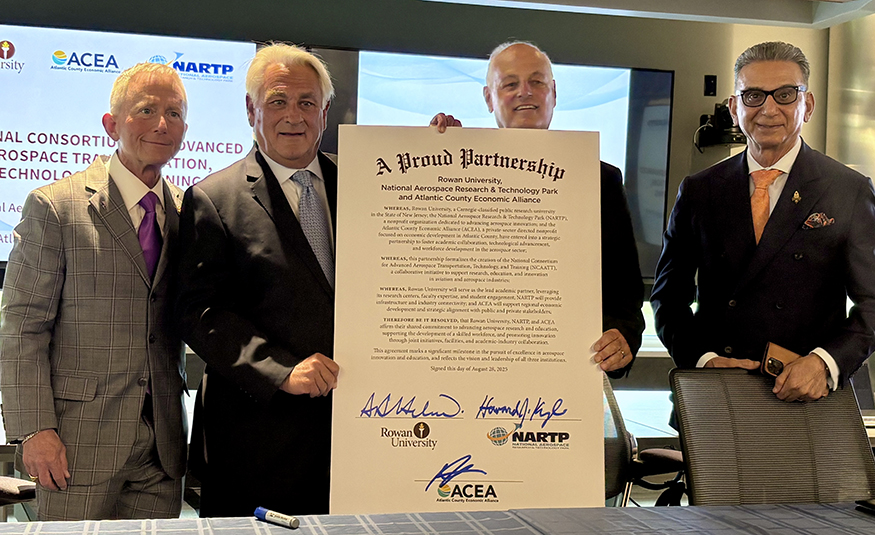
Rowan University, the National Aerospace Research & Technology Park, and Atlantic County Economic Alliance announced signing a Memorandum of Understanding in September to advance aviation research.
The MOU sets the foundation for building a statewide and national academic consortium around aviation technology, safety and workforce development.
Under the agreement, Rowan, NARTP and ACEA will serve as original members and facilitators. The partners will work to establish a framework for a broad coalition comprised of research universities, nonprofits and government agencies, as well as private-sector companies. Applied Research Associates will serve as an industry partner in this effort, the partners said.
As facilitators, the partners say they aim to boost the state’s role as a national hub for aerospace innovation.

“South Jersey has the potential to become a national hub for innovation in all aspects of aerospace research and engineering,” said Rowan University President Ali Houshmand. “Given our combined resources and entrepreneurial thinking, we have all the necessary pieces to make that a reality. Just as we’ve done with health care in our region, we and our new partners will build a solid foundation for future collaboration and growth.”
NARTP sits adjacent to the Federal Aviation Administration (FAA) William J. Hughes Center for Advanced Aerospace and the Atlantic City International Airport. That location offers direct access to federal research facilities, specialized testbeds and an already established innovation ecosystem.
Other developments in the sector:
- CoreWeave to acquire Monolith AI for industrial cloud growth
- Stevens Institute receives $21M gift from Clark Foundation
The consortium aims to support projects in artificial intelligence, advanced air mobility, unnamed systems, aviation cybersecurity and related fields.
The group will also advance the creation of a Strategic Innovation Center at NARTP, which will house its activities.
Supported by $8.6 million in funding from the New Jersey Economic Development Authority, the Aerospace Innovation Center SIC is the state’s first to focus on aviation. When it was announced, officials said the 40,000-square-foot, two-story facility was expected to be up and running by January 2026. The project topped out this past May.
“This agreement is not just about research — it’s about creating an economic engine for our region,” said Michael Viscount, chairman of the Atlantic County Economic Alliance.