Sign In
Upcoming Event
 Free Newsletter

All aboard: Murphy, legislative leaders reach CTF deal (updated)
Corporate transit fee would last 5 years to help fund NJ Transit
Matthew Fazelpoor//June 24, 2024//

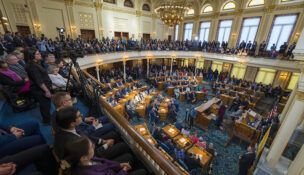
Gov. Phil Murphy delivered his seventh annual budget address on Feb. 27, 2024, in Trenton, outlining spending priorities for Fiscal Year 2025. - PROVIDED BY RICH HUNDLEY III/NJ GOVERNORS OFFICE
Gov. Phil Murphy delivered his seventh annual budget address on Feb. 27, 2024, in Trenton, outlining spending priorities for Fiscal Year 2025. - PROVIDED BY RICH HUNDLEY III/NJ GOVERNORS OFFICE
All aboard: Murphy, legislative leaders reach CTF deal (updated)
Corporate transit fee would last 5 years to help fund NJ Transit
Matthew Fazelpoor//June 24, 2024//


)

 Listen to this article
Just before the weekend, Gov. Phil Murphy and Democratic legislative leaders struck a deal on one of the most controversial items in his current budget proposal, the corporate transit fee (CTF).
To help fund the financially beleaguered NJ Transit, the tax will hit nearly 600 of the state’s most profitable businesses that make at least $10 million a year in profits.
Neither the governor nor Senate President Nick Scutari, D-22nd District, and Assembly Speaker Craig Coughlin, D-19th District, have announced the deal publicly yet; however, sources familiar with the negotiations confirmed the agreement to NJBIZ. Politico New Jersey first reported the deal.
Under the agreement, the CTF would not be permanent. Put in place for the next five years, the levy will be retroactive to Jan. 1, 2024 — something the business community had advocated against. The sales tax will not rise to 7% either, an option that had been floated late in the budget hearing process to raise revenue.
As NJBIZ reported Friday prior to this deal, business leaders expected CTF as part of the budget agreement – but were hopeful it would be temporary.
Wait and see
In response to the reported agreement, the New Jersey Business & Industry Association (NJBIA) said they are in “wait-and-see mode.”

“Obviously, a temporary tax is better than a permanent one. But including that retroactivity of the tax going back to Jan. 1, after the governor’s year-long promise to sunset the temporary CBT, is a major and impactful hit that borders on punitive,” NJBIA President and CEO Michele Siekerka told NJBIZ in a statement. “Especially when you consider these impacted businesses will have to restate their financials for the first half of the year for taxes they’ve already for the first half of the year for taxes they’ve already paid.”
Siekerka stressed that if this is what it’s going to be – with no meaningful concessions or structural spending reforms to make the budget more affordable – then it will come across as a blatant disregard for the consequences and impacts that her organization and the broader business community have shared for months.
“These are coming directly from our impacted job creators,” said Siekerka. “It will also confirm that regional competitiveness means nothing to our policymakers. If this is the result – it will be a sad and defining moment for our business community, with broken promises and no regard for their input. It is a line in the sand that will have been crossed.”
Siekerka also reiterated something she told NJBIZ last week.
“Further, if this tax prevails, we can only pray that the revenue makes its way one year from now to its intended purpose – NJ Transit,” she said. “We feel that may be unlikely given the public discussions recently by our policymakers about how they would like to use this money elsewhere. We can only hope we are not standing here next year discussing more broken promises.”
A ‘nightmare’ come true?
In a Monday morning post, New Jersey Chamber of Commerce President and CEO Tom Bracken said that the “nightmare” budget scenario he and other business leaders feared might be coming true.

“In these final days, we will continue to make our case that the CTF to ‘fund’ New Jersey Transit – and fill the structural deficit in the budget – is bad for those 600 companies impacted, it is bad for our overall long-term economy and bad for our business and attraction efforts,” said Bracken. “It gives New Jersey the highest business tax in the nation – and effectively wipes out much of the progress and momentum our state has enjoyed. The budget also does nothing to solve New Jersey’s long-term structural budget deficits. We continue to spend more than we make.”
Bracken noted the that the many business community members he has spoken with since the news of the deal broke are “deeply disappointed” about the CTF. And while he was hopeful about the conversations between the business community and government leaders/stakeholders during the budget process, it appears that the business community is receiving little support in this budget.
“In fact, it’s one of the worst state budgets in recent memory for the employer community,” Bracken continued.
He said while the five-year expiration of the CTF was a minor concession for businesses – a lot can happen in that time – and that these next five years will be critical to the future direction of our economy.
“Our state cannot continually ignore our long-term economic needs in favor of quick fixes, like the CTF, that address ‘today’ issues,” Bracken closed out his message. “Many of our friends in the state Legislature will be in office over the next five years – and their votes on this budget will chart their own destiny. Time is running out for New Jersey. This week will say a lot about how serious New Jersey is about economic growth being a priority – or whether it is business as usual in Trenton.”
A turning point?
On the other side of the issue, several advocacy groups applauded the deal.
“We commend the governor and legislative leadership for dedicating a revenue source for NJ Transit for the first time in its 45-year history and ensuring that funding comes from the corporations who have soaked up the lion’s share of economic activity since the pandemic,” said Peter Chen, senior policy analyst at New Jersey Policy Perspective (NJPP).
“Over the past few weeks, we’ve seen the consequences of decades of disinvestment in the state and country’s transit infrastructure,” said Maura Collinsgru, director of policy and advocacy at New Jersey Citizen Action, referencing recent rail service meltdowns encountered by riders. “And we hope that this announcement serves as a turning point for the state in recognizing that big investments require wealthy corporations to pay their fair share.”
Despite having reached this agreement, the rest of the budget process remains fluid. Negotiations continue as the action picks back up in Trenton this week. Lawmakers have until midnight June 30 to try and strike a deal on the governor’s $56 billion spending plan.
Editor’s note: This story was updated at 11:19 a.m. ET June 24, 2024, to include a statement from New Jersey Chamber of Commerce President and CEO Tom Bracken.