Sign In
Upcoming Event
 Free Newsletter

Excitement and tension: NJ ramps up 2026 World Cup preparations (updated)
Matthew Fazelpoor//May 11, 2026//
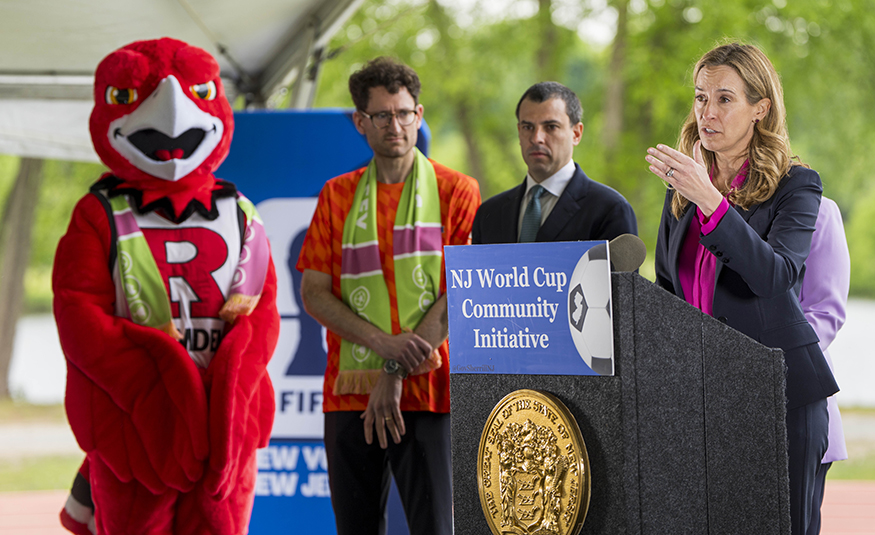
On May 6, 2026, at Cooper River Park in Pennsauken, Gov. Mikie Sherrill announced the award winners of the World Cup 2026 Community Initiative Grant Program. Behind Sherrill, from left: Rutgers–Camden Scarlet Raptor mascot; Evan Weiss, NJEDA CEO; and Alex Lasry, NYNJ Host Committee CEO. - PROVIDED BY NJ GOVERNOR'S OFFICE/TIM LARSEN
On May 6, 2026, at Cooper River Park in Pennsauken, Gov. Mikie Sherrill announced the award winners of the World Cup 2026 Community Initiative Grant Program. Behind Sherrill, from left: Rutgers–Camden Scarlet Raptor mascot; Evan Weiss, NJEDA CEO; and Alex Lasry, NYNJ Host Committee CEO. - PROVIDED BY NJ GOVERNOR'S OFFICE/TIM LARSEN
Excitement and tension: NJ ramps up 2026 World Cup preparations (updated)
Matthew Fazelpoor//May 11, 2026//


)

The basics:
- New Jersey awarded $5M in World Cup community grants statewide
- Cities are launching festivals, fan zones and hospitality activations
- NJ Transit and FIFA continue debating World Cup transportation costs
- MetLife Stadium will host eight matches, including the World Cup Final
With kickoff for the 2026 FIFA World Cup now just weeks away, New Jersey’s preparations are shifting from planning to execution, as a steady stream of festivals, grant announcements, transportation planning, and hospitality activations begin to move from concepts on paper to events on the ground.
A May 6 announcement in Pennsauken underscored that shift. Gov. Mikie Sherrill revealed more than $5 million in New Jersey World Cup Community Initiative grants to 34 New Jersey-based organizations during the event. The funding is aimed at supporting local festivals, watch parties, cultural programming and small business-led activations across the state. That approach was adopted after the governor scrapped a previously planned, single Fan Fest set for Jersey City’s Liberty State Park throughout the tournament – instead opting for a statewide approach.
The funding is framed as a way to push World Cup activity beyond stadium districts and into communities that might not otherwise directly benefit from the tournament. MetLife Stadium will host eight matches while Lincoln Financial Field in Philadelphia will host six.
Fun for all
“The FIFA World Cup 2026 is a once-in-a-generation opportunity to showcase New Jersey on the global stage, and we want to make sure all New Jerseyans can join in on the festivities,” said Sherrill. “These grants will help ensure that the benefits of hosting the World Cup extend beyond the walls of the stadium. Through this initiative, we are supporting small businesses and empowering communities across New Jersey to create exciting experiences that bring residents and visitors together throughout our state ahead of the tournament, and during the World Cup.”
These grants will help ensure that the benefits of hosting the World Cup extend beyond the walls of the stadium.
– Gov. Mikie Sherrill
“This initiative, launched by Gov. Sherrill, will help turn the world’s largest sporting event into an economic driver for local communities and small businesses across New Jersey,” said Evan Weiss, CEO of the New Jersey Economic Development Authority. The NJEDA developed and funded the initiative as well as approved grant awards. The NYNJ Host Committee selected Choose New Jersey to administer the grant application and distribution process.
“Choose New Jersey is proud to support this initiative by helping bring these community-driven ideas to life,” said Amy Herbold, president and CEO of Choose New Jersey.

“Our goal is to make the World Cup experience accessible and felt in every corner of the region,” said NYNJ Host Committee CEO Alex Lasry. “These community events extend the tournament far beyond the stadium – creating authentic fan experiences that reflect the diversity, pride, and energy that define New Jersey, while ensuring residents and visitors alike can be part of this once-in-a-generation moment.”
Celebrations kicking off
And there is a dense slate of activities and events rolling out throughout the state.
In Newark, the “Kick it in Newark” campaign is launching a Flag Cities festival at Mulberry Commons June 24, along with hotel packages, visitor trails and hospitality ambassadors positioned at transit hubs. Hoboken is folding the tournament into its broader summer calendar through its Arts and Music Festival, and a series of block parties and downtown street activations tied to World Cup viewing and community programming. New Brunswick’s “Hub City Fan Celebration” will produce watch parties at The Yard on the Rutgers campus, while Harrison’s Sports Illustrated Stadium is preparing a dedicated fan hub with match screenings and cultural programming. Jersey City’s Liberty Science Center will run its “Summer of Soccer & Science” series, blending STEM programming with live match viewing.
The Meadowlands Regional Chamber’s Flag Cities initiative will span four counties, with events planned in Newark, Jersey City, Paterson, Hackensack, Secaucus and Bayonne. The New Jersey Performing Arts Center-led North to Shore Festival will layer World Cup-themed programming into its June-to-July arts footprint across Essex, Monmouth and Atlantic counties. Additional events range from Atlantic City beach festivals and Union City soccer celebrations to Princeton food markets, Trenton youth programming, Paterson’s “Passport to Paterson” series, and a broad mix of township-level watch parties and cultural festivals across the state.

American Dream in East Rutherford is preparing a 39-day Dream Fan Fest that will run for the duration of the tournament, featuring daily viewing parties, concerts, and immersive entertainment programming across its retail and attractions campus. The adjacent “La Plaza de Fútbol” marketplace is expected to bring up to 1,000 small businesses into a high-traffic retail environment designed to capture tournament-driven visitation. The state’s “Welcome World Rewards Program,” launching May 25, will add a digital layer. The initiative allows fans to earn points for visiting participating businesses across New Jersey and New York City.

Together, the mix of grants, municipal programming and private-sector activations is shaping a statewide calendar that is quickly filling June and July with events well beyond the match schedule itself.
But not all fun and games
At the same time, the final stretch of preparation has not been without friction — particularly around transportation and logistics as large crowds prepare to move across a compressed regional footprint.
The World Cup
in New Jersey
Where and when the tournament action will take place over the summer
Games in East Rutherford
(All times Eastern)
Group stage
Brazil vs. Morocco (Group C)
June 13, 6 p.m.
France vs. Senegal (Group I)
June 16, 3 p.m.
Norway vs. Senegal (Group I)
June 22, 8 p.m.
Ecuador vs. Germany (Group E)
June 26, 4 p.m.
Panama vs. England (Group L)
June 27, 5 p.m.
Knockout stage
Round of 32
June 30, 5 p.m.
Round of 16
July 5, 4 p.m.
Final
July 19, 3 p.m.
Training sites
RWJBarnabas Health Red Bulls Performance Center, Morris Township
Brazil
The Pingry School, Basking Ridge
Morocco
Rutgers University, Piscataway
Senegal
Stockton University, Galloway Township
Haiti
Sources: FIFA, media reports
NJ Transit originally set a $150 round-trip fare from New York Penn Station to MetLife Stadium on match days, since reduced to $105. The pricing is part of a broader effort to manage peak demand as the venue prepares to host eight matches, including the World Cup Final July 19. [See box] The stadium will not offer general parking on match days, increasing reliance on rail service, shuttle buses and coordinated transit movement. The pricing model has drawn scrutiny from fans and FIFA, which raised concerns about affordability and potential impacts on attendee access.
NJ Transit President and CEO Kris Kolluri has defended the structure as a necessary operational step given the scale of the event and infrastructure constraints. He has pointed to the need to fund additional service, manage crowd flow, and coordinate security across a heavily concentrated schedule of arrivals and departures. Kolluri also heads the New Jersey Turnpike Authority.
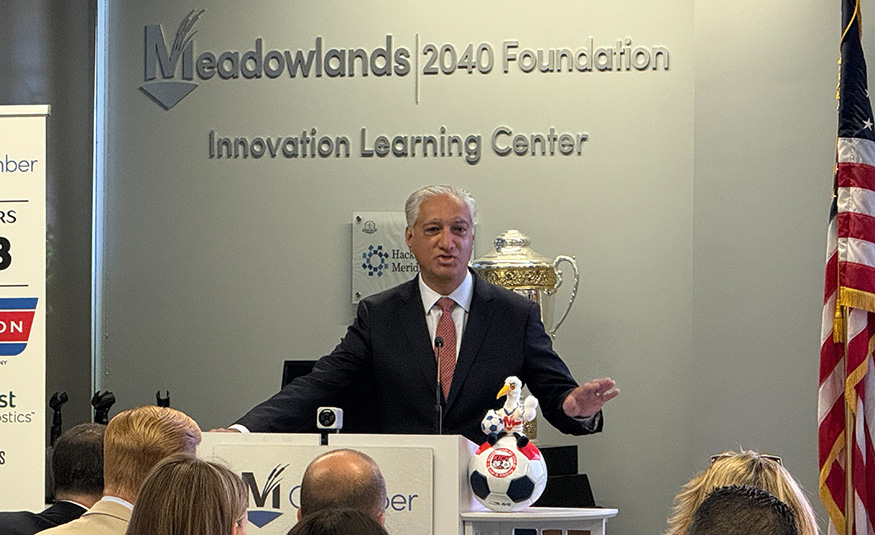
“Yes, it’s $150 a round trip, but let me explain why that is important,” he said during a recent Meadowlands Chamber event on this very topic. “I think that the governor’s statement that New Jersey commuters are not going to subsidize the travel of fans actually makes sense if you step back and think about it for a second.
“The governor’s perspective is this is an experience for the fans, and we want to make sure there’s a good transportation system, and that cost to run the system for the eight games is $6 million a game – or $48 million for the eight games.”
Firm stance
“There is no way I’m going to have the people of New Jersey paying for this,” Sherrill said during that May 6 event, recounting what she told Kolluri regarding World Cup transportation costs. “That’s just not right. So that is where we came up with the ticket price.”
This period has also been marked by some back-and-forth between FIFA and Sherrill, who has taken a firm stance on this issue and sought to defray transportation costs. “At the same time, FIFA anticipates they’ll make about $11 billion from this event,” said Sherrill. “I’ve suggested to them, and we’ve been in talks with them, that they should defray some of this cost. And we’re also talking to local sponsors who are interested in defraying some of the cost.”
When New Jersey announced its transportation plan last month, FIFA responded:
“The NJ Transit current pricing model will have a chilling effect,” Heimo Schirgi, chief operating officer for FIFA World Cup 2026, told NJBIZ in a statement. “Elevated fares inevitably push fans toward alternative transportation options. This increases concerns of congestion, late arrivals, and creates broader ripple effects that ultimately diminish the economic benefit and lasting legacy the entire region stands to gain from hosting the World Cup.
“Furthermore, to arbitrarily set elevated prices and demand FIFA absorb these costs is unprecedented,” Schirgi continued.
Do not walk
The exchange reflects a broader tension between delivering a global-scale event and managing the financial and logistical burden on local systems. The transportation debate has become one of the most visible pressure points in the lead-up to kickoff, even as officials emphasize that planning is designed to keep people moving safely and efficiently across rail, bus and regional transit networks. They’ve also stressed to fans that no one should attempt to walk to the stadium — an idea that was hatched and discussed on social media.
“Walking is the worst thing you can ever do in this environment,” Kolluri said. He emphasized the goal is for fans to enjoy the event “and not risk it.”
“It’s also illegal to walk to MetLife Stadium,” Lasry added. “It’s not safe, but it’s also illegal.”
Against that backdrop, a recent American Hotel & Lodging Association report finds hotel bookings in the New York City–New Jersey host market are running below early expectations, despite more than 5 million tickets sold. So far, demand tracks closer to typical summer levels than a World Cup-driven surge.
Spotlight on the World Cup
Also in this special section:
- NJ restaurants, bars gear up for 2026 FIFA World Cup crowds
- Bohler helps Pingry secure spot as World Cup practice base
The shortfall is largely tied to weaker international travel, with roughly 70% of respondents citing visa delays and geopolitical concerns, along with inflated early FIFA room blocks that have since seen widespread cancellations and returned inventory. In New Jersey, the outlook is further clouded by proposed increases in lodging and sales taxes tied to the event, adding further pressure to already soft demand conditions.
Buzz continues to grow
But despite those challenges, there is a palpable buzz growing as this long-anticipated event nears reality and brings potential generational opportunity economic impact along with it.
Beyond the games and festivities, New Jersey will also host four team base camps.
“And that’s a big economic benefit as well. Morocco [The Pingry School], Senegal [Rutgers University], Brazil [RWJBarnabas Health Red Bulls Performance Center], and Haiti [Stockton Univesity] will be basing here in New Jersey,” said Sherrill in Basking Ridge May 5 for the official Morocco announcement. “That’s the whole team here, utilizing facilities, as well as their family, coaching staff, etc. So that’s also going to be a nice economic impact for us.”

Brazil vs. Morocco is the first match taking place held at MetLife Stadium, June 13, which also marks one of the marquee matches of the Group Stage.
A broader communications rollout is expected in the coming weeks to provide additional guidance for businesses, municipalities and residents as logistics and operations come into sharper focus ahead of the tournament. Sherrill stressed a deliberate focus on spreading opportunity beyond the stadium footprint and into communities across the state.
“It was really important to me that we saw economic benefit going to local vendors and local restaurants up and down the state, because we have a really great opportunity here – not just to create economic benefit from what’s going on in North Jersey at the Meadowlands, but really to feed off that across the state, and even some of the benefit coming from the Philly games,” she said.
Editor’s note: This story was updated at 9:07 a.m. June 14, 2026, to correct that the first match in East Rutherford is Brazil vs. Morocco.